Ray Test
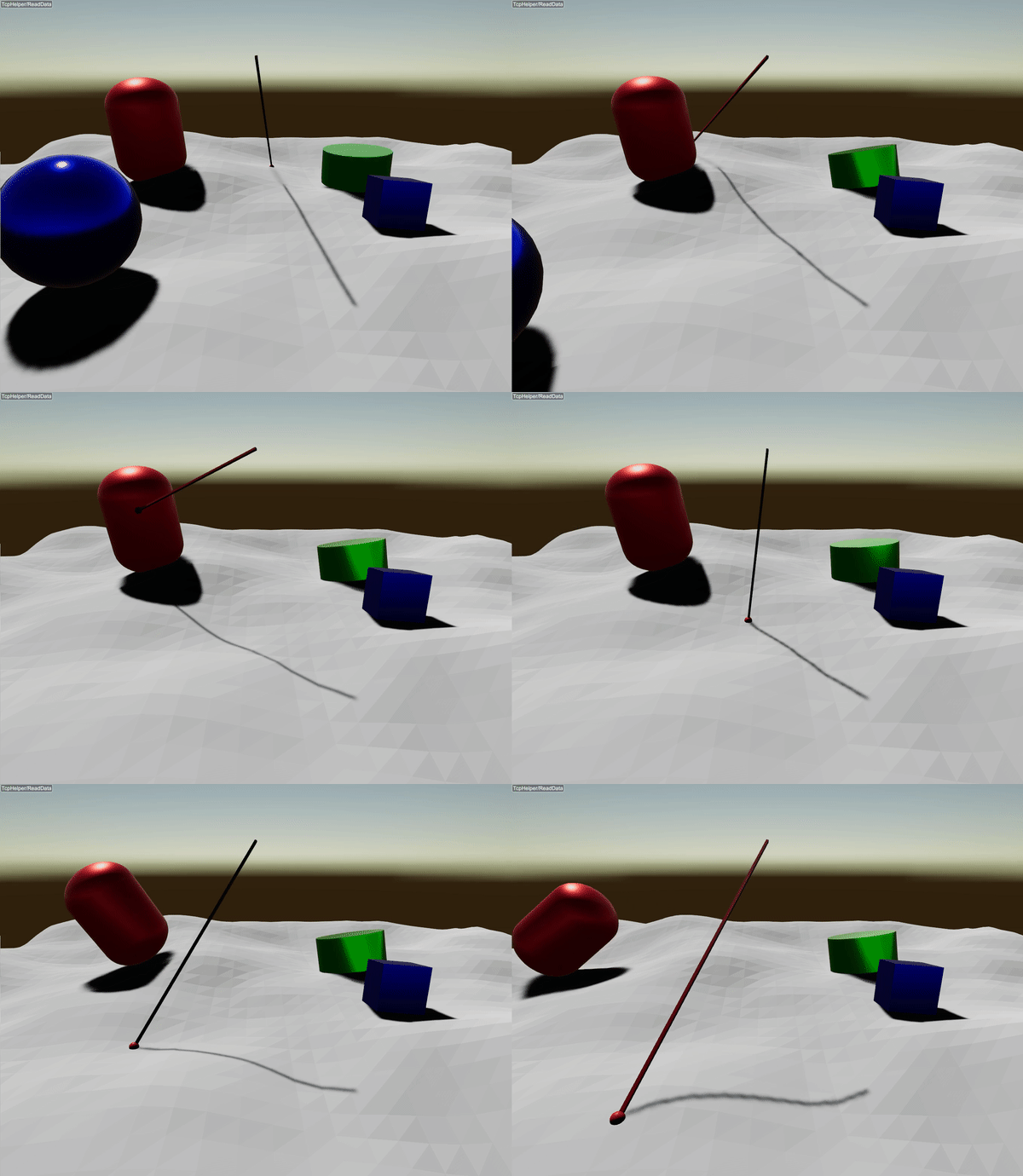
A ray test is a collision check between the world and a ray. Users specify the starting point, direction, and length. It returns the closest hit along the ray (if any).
Arguments
Single-ray test (rayTest)
Signature (C++):
const RayCollisionList& rayTest(const Eigen::Ref<const Eigen::Vector3d, Eigen::Unaligned>& start,
                                const Eigen::Ref<const Eigen::Vector3d, Eigen::Unaligned>& direction,
                                double length,
                                size_t objectId = size_t(-10),
                                size_t localId = size_t(-10),
                                CollisionGroup collisionMask = CollisionGroup(-1));
Overloads accept {x, y, z} initializer lists for start, direction,
or both. Pass a raisim::Vec<3> as vec.e().
start: ray origin in world frame.direction: ray direction in world frame. It is normalized internally, so it does not need to be a unit vector; a zero vector is treated as +z.length: ray length in meters. Only hits within [0, length] are returned; a non-positive length returns no hit.objectId/localId: optional self-filter. Collisions with the body whose object world index (Object::getIndexInWorld()) and local body index match are ignored (useful for sensors attached to robots). Both must be set for the filter to take effect; the defaults disable it.collisionMask: collision mask to filter which groups the ray can hit. The default (-1) allows all groups.
The returned RayCollisionList stores only the closest hit (0 or 1 item).
Example
The ray test itself is a single call:
auto& col = world.rayTest({0,0,5}, direction, 50.);
The ray_casting example sweeps this ray over the ground and visualizes the
hit point through RaisimServer.
Getting the hit object (example)
To identify what was hit, check the returned RayCollisionList.
const auto& hits = world.rayTest({0, 0, 5}, direction, 50.0);
if (hits.size() == 0) {
  std::cout << "No hit\n";
} else {
  const auto& hit = hits[0];
  const auto* obj = hit.getObject();
  if (obj) {
    std::cout << "Hit object: " << obj->getName()
              << " (id=" << obj->getIndexInWorld() << ")\n";
  }
  std::cout << "Hit position: " << hit.getPosition().transpose() << "\n";
  const auto body = hit.getCollisionBody();
  if (body) {
    std::cout << "Collision body: " << body->name << "\n";
  }
}
Batch ray tests (lidar)
For spinning lidar-style scans, World::rayTestLidar(...) generates a
rectangular yaw/pitch sampling pattern and performs the scan in one call.
Signature (C++):
void rayTestLidar(
    const Mat<3, 3>& rot,
    const Vec<3>& pos,
    double yawStartAngle,
    double yawIncrement,
    size_t yawCount,
    double pitchStartAngle,
    double pitchIncrement,
    size_t pitchCount,
    double rangeMin,
    double rangeMax,
    size_t objectId,
    size_t localId,
    CollisionGroup collisionMask,
    std::vector<Vec<3>, AlignedAllocator<Vec<3>, 32>>& scan);
Both angular axes use the same start angle, increment, count convention.
For sample indices \(y\) and \(p\), the angles are
where \(0 \le y < \mathrm{yawCount}\) and
\(0 \le p < \mathrm{pitchCount}\). Increments are signed: use a negative
increment to scan an axis in the decreasing-angle direction. A single-sample
axis normally uses an increment of zero. If either count is zero, an angle is
not finite, or rangeMax <= rangeMin, scan is cleared and no
rays are cast.
Each ray direction in the sensor frame is
so yaw rotates about the sensor z axis starting from the sensor x axis, and a positive pitch tilts the ray toward the sensor +z axis.
Minimal example for a complete yaw revolution with 16 pitch channels
(rot, pos, rangeMin, rangeMax, objectId, localId, and
collisionMask come from the application):
constexpr double pi = 3.14159265358979323846;
constexpr size_t yawCount = 1024;
constexpr size_t pitchCount = 16;
constexpr double yawStartAngle = -pi;
constexpr double yawIncrement = 2.0 * pi / double(yawCount);
constexpr double pitchStartAngle = -15.0 * pi / 180.0;
constexpr double pitchEndAngle = 15.0 * pi / 180.0;
constexpr double pitchIncrement =
    (pitchEndAngle - pitchStartAngle) / double(pitchCount - 1);

std::vector<raisim::Vec<3>, raisim::AlignedAllocator<raisim::Vec<3>, 32>> scan;
world.rayTestLidar(rot, pos,
                   yawStartAngle, yawIncrement, yawCount,
                   pitchStartAngle, pitchIncrement, pitchCount,
                   rangeMin, rangeMax,
                   objectId, localId, collisionMask,
                   scan);
Yaw is the outer loop and pitch is the inner loop. Consequently, rays are generated in this order:
(yaw[0], pitch[0]), (yaw[0], pitch[1]), ...,
(yaw[1], pitch[0]), (yaw[1], pitch[1]), ...
The output scan contains hit points in the sensor frame. It is compact:
only rays that hit contribute a point, so a miss does not create a placeholder
entry and indices after a miss no longer map directly to angular sample indices.
Arguments (batched lidar scan)
rot: sensor orientation (sensor frame to world frame).pos: sensor position in world frame.yawStartAngle,yawIncrement,yawCount: first yaw angle, signed yaw step, and number of yaw samples.pitchStartAngle,pitchIncrement,pitchCount: first pitch angle, signed pitch step, and number of pitch samples.rangeMin,rangeMax: minimum and maximum sensor-relative range in meters. Each collision ray starts atrangeMinand has lengthrangeMax - rangeMin.objectId/localId: optional self-filter (same asrayTest).collisionMask: collision mask to filter which groups the rays can hit.scan: output hit positions in the sensor frame.
Performance notes
rayTestLidar is optimized for repeated structured scans. It caches the
sensor-frame directions and their normalized forms for an unchanged yaw/pitch
pattern. In a sufficiently large, spatially sparse scene it also builds
conservative angular candidate buckets, so each ray normally checks only nearby
bodies. The buckets are reused while the scene, sensor pose, ranges, self-filter,
and collision mask are unchanged; changes to any of those inputs invalidate the
relevant cache. Bucket bounds are conservative and every retained candidate
still goes through an exact shape intersection. Sphere candidates use the same
quadratic roots and range rules as the contact engine but omit the unused
contact-normal calculation. No path approximates hit positions.
Dense or unsupported angular configurations automatically use the exact ray BVH instead. Small scenes use a scan-wide conservative cull and a compact flat candidate list. These fallbacks preserve the same closest-hit and compact-output semantics.
Use the public ray_scan_lidar example to inspect structured scans and
large_scale_ray_test to inspect repeated ray queries. Build them together
with the TCP viewer and start the viewer:
cmake --build build-examples --target ray_scan_lidar large_scale_ray_test rayrai_tcp_viewer --parallel 12
./build-examples/examples/rayrai_tcp_viewer
Then start either simulation (for example,
./build-examples/examples/ray_scan_lidar) in another terminal. These examples visualize the APIs;
they are not timing comparisons. For application benchmarks, time
World::rayTestLidar and repeated World::rayTest calls with identical
sensor poses, rays, ranges, and collision filters on one thread, and verify the
hit positions before comparing timings. Relative speed depends on scene layout,
motion, filters, and scan shape.
Details
RayCollisionItem summary
Each hit entry stores:
getObject(): pointer to the hitraisim::Object(or nullptr if none).getPosition(): world-frame hit position as anEigen::Vector3d.getCollisionBody(): pointer to the collision body that was hit (may be null for some objects).
RayCollisionList summary
Container semantics:
size(): number of valid hits in the list.operator[](i): random access to the i-th hit.begin(),end(): iterators over valid hits.back(): iterator to the last valid hit.setSize(n): updates the number of valid hits (used internally).resize(n),reserve(n): storage management.
Notes
RayCollisionListis a lightweight container owned by the world and reused across calls. EveryrayTest(...)call overwrites it, so copy any hit you need before the next ray test.It contains at most one item because RaiSim keeps only the closest hit along the ray. Use
list.size()to check whether a hit occurred (0 or 1).
API
RayCollisionItem
-
class RayCollisionItem
One ray hit returned by World::rayTest().
RayCollisionList
-
class RayCollisionList
Hit list returned by World::rayTest(). Only the first size() entries are valid; the storage is reused by the next ray test.
Public Types
-
using iterator = basic_iterator<false>
Mutable hit iterator.
-
using const_iterator = basic_iterator<true>
Const hit iterator.
Public Functions
-
inline RayCollisionItem &operator[](size_t i)
Access an item by index.
- Parameters:
i – [in] Index into the hit list. Not bounds-checked; only indices below size() hold valid hits.
- Returns:
Hit entry at the given index.
-
inline const RayCollisionItem &operator[](size_t i) const
Access an item by index.
- Parameters:
i – [in] Index into the hit list.
- Returns:
Hit entry at the given index.
-
inline size_t size() const
- Returns:
Number of valid hits.
-
inline const_iterator begin() const
- Returns:
const iterator to the first hit
-
inline const_iterator end() const
- Returns:
const iterator past the last hit
-
inline const_iterator cbegin() const
- Returns:
const iterator to the first hit
-
inline const_iterator cend() const
- Returns:
const iterator past the last hit
-
inline const_iterator back() const
- Returns:
const iterator to the last hit (a null iterator if the list is empty)
-
inline void setSize(size_t size)
Set the number of valid hits in the list.
- Parameters:
size – [in] Number of hits, clamped to the storage size.
-
inline void resize(size_t size)
Resize the storage for hit entries.
- Parameters:
size – [in] New storage size.
-
inline void reserve(size_t size)
Reserve storage for hit entries.
- Parameters:
size – [in] Capacity to reserve.
-
template<bool IsConst>
class basic_iterator Forward iterator over the valid hits (const or mutable).
Public Functions
-
inline explicit basic_iterator(pointer ptr)
- Parameters:
ptr – [in] item the iterator points to
-
template<bool OtherConst, typename = std::enable_if_t<IsConst && !OtherConst>>
inline basic_iterator(const basic_iterator<OtherConst> &other) Conversion from a mutable to a const iterator.
- Parameters:
other – [in] mutable iterator
-
inline self_type &operator++()
prefix: advance, then return the new (incremented) iterator
- Returns:
this iterator
-
inline self_type operator++(int)
postfix: return a copy of the pre-increment value
- Returns:
the iterator before incrementing
-
inline reference operator*() const
- Returns:
the current item
-
inline pointer operator->() const
- Returns:
pointer to the current item
-
inline bool operator==(const self_type &rhs) const
- Parameters:
rhs – [in] other iterator
- Returns:
true if both point to the same item
-
inline bool operator!=(const self_type &rhs) const
- Parameters:
rhs – [in] other iterator
- Returns:
true if they point to different items
-
inline explicit basic_iterator(pointer ptr)
-
using iterator = basic_iterator<false>