Height Map Using a PNG File
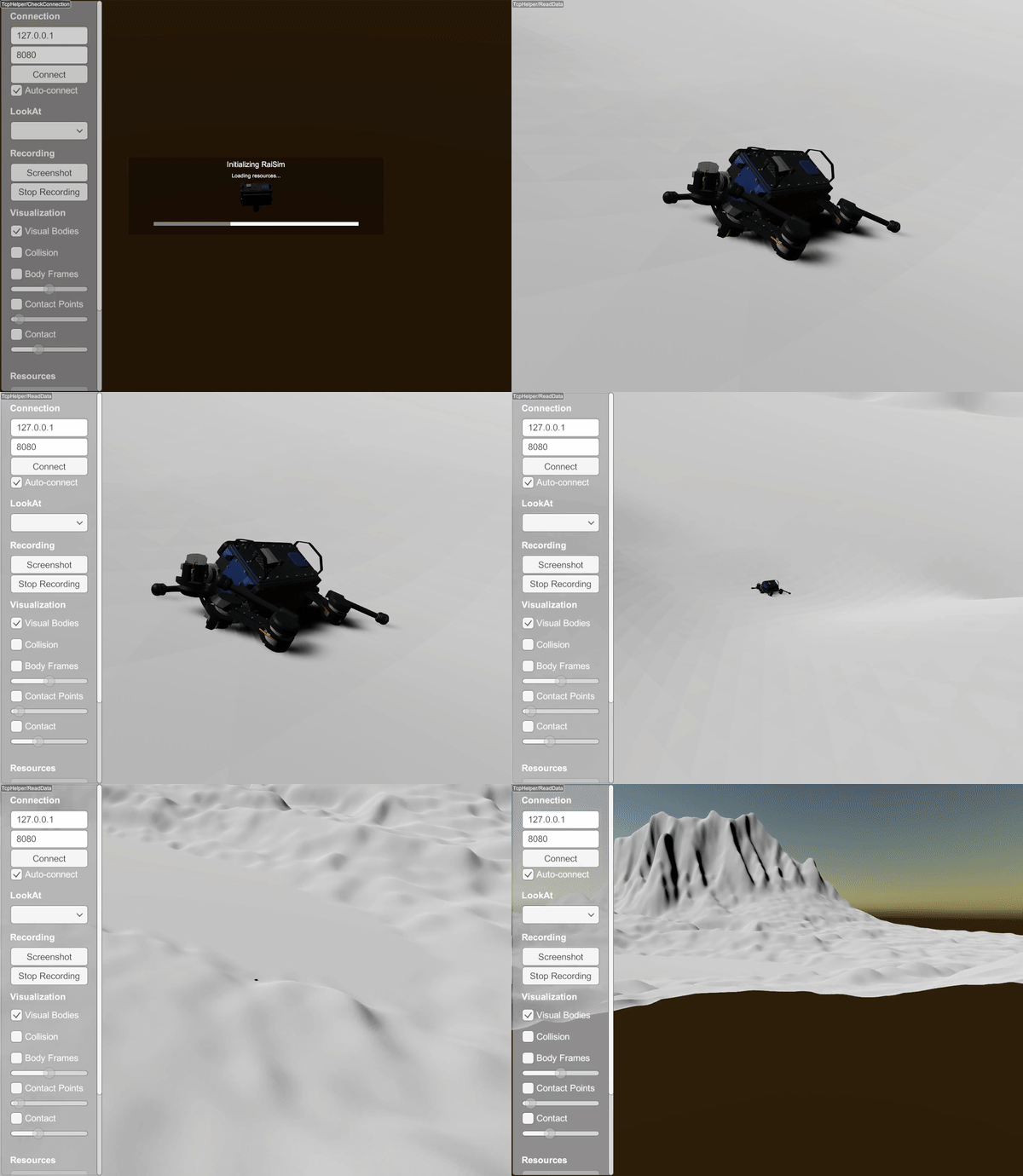
The PNG must be an 8-bit or 16-bit grayscale image. Each pixel becomes one
height sample with the value pixelValue * heightScale + heightOffset, and
the image width and height set the number of samples along x and y.
XML approach
The matching asset is
rsc/xmlScripts/heightMaps/heightMapUsingPng.xml. Load it through the world
configuration constructor in your application:
raisim::World world("/path/to/raisim2Lib/rsc/xmlScripts/heightMaps/heightMapUsingPng.xml");
The XML file is equivalent to the following. The asset spells the attributes
in snake_case (x_size, center_x, z_offset, z_scale, …); the
reader accepts both spellings.
<?xml version="1.0" ?>
<raisim version="2.0.0">
    <timeStep value="0.001"/>
    <objects>
        <articulatedSystem name="anymal" resDir="[THIS_DIR]/../../anymal" urdfPath="[THIS_DIR]/../../anymal/urdf/anymal.urdf" collisionGroup="1" collisionMask="-1">
            <state qpos="0, 0, 10.84, 1.0, 0.0, 0.0, 0.0, 0.03, 0.4, -0.8, -0.03, 0.4, -0.8, 0.03, -0.4, 0.8, -0.03, -0.4, 0.8"
                   qvel="0 0 0 0 0 0 0 0 0 0 0 0 0 0 0 0 0 0" />
        </articulatedSystem>
        <heightmap name="terrain" png="[THIS_DIR]/zurichHeightMap.png" xSize="500" ySize="500" centerX="0" centerY="0" heightOffset="-10" heightScale="0.005"/>
    </objects>
</raisim>
C++ approach
The arguments are the PNG path, centerX, centerY, xSize, ySize,
heightScale, and heightOffset:
auto* heightMap = world.addHeightMap("/path/to/zurichHeightMap.png",
                                     0, 0, 500, 500, 0.005, -10);