Changelog: v2.3.0
This release introduces native rolling and spinning friction in the
contact solver, interactive sim control (pause / step / force / pose
from the rayrai TCP viewer), MJCF loading into an existing
raisim::World, a persistent shader binary cache and multi-threaded
prewarming for rayrai, makes the rayrai renderer look right with zero
per-application tuning, splits the rayrai documentation into navigable
subsections, and adds compile-time-regenerated reference images for the
documentation.
Rolling and spinning friction
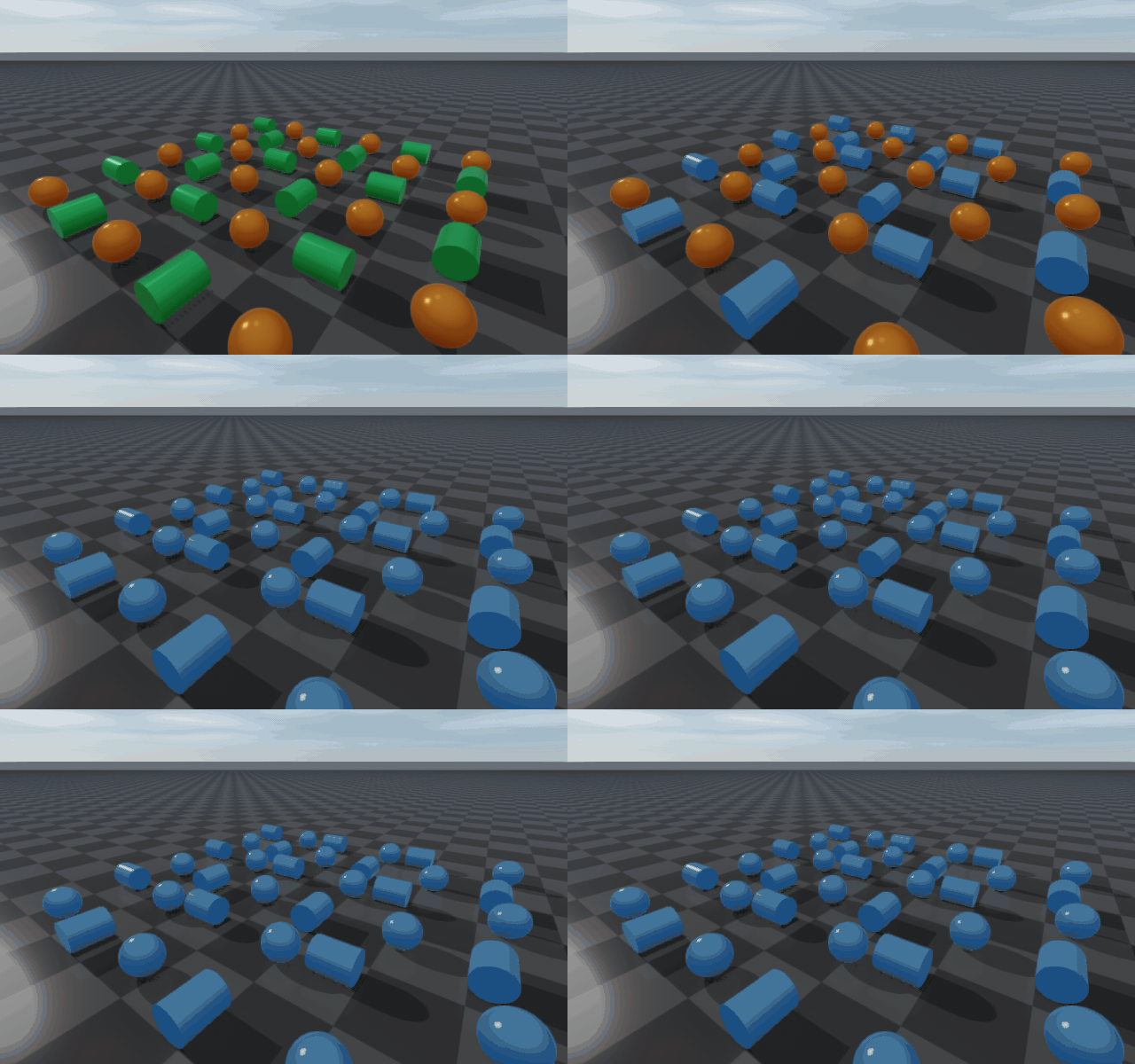
RaiSim’s contact solver now models two extra friction modes alongside classical Coulomb friction:
Rolling friction (\(\mu_r\)) resists rotation that would roll a finite-radius body over a contact patch. This is what stops a ball or a cylinder from spinning freely down a slope under gravity alone — useful for ball bearings, wheels on soft ground, and any contact where the contact patch is non-zero.
Spinning friction (\(\mu_s^{spin}\)) resists torsional rotation about the contact normal — the kind of motion you see when a spinning top stops, or when a robot foot torques in place.
Both coefficients default to zero, so existing simulations behave exactly
as before. Opt in per material pair through World::setMaterialPairProp:
world.setMaterialPairProp(
  "steel", "rubber",
  0.80,   // dynamic friction
  0.10,   // restitution
  0.001,  // restitution threshold
  0.90,   // static friction
  0.001,  // static-friction threshold velocity
  0.05,   // rolling friction
  0.02);  // spinning friction
If any active contact in a frame has nonzero rolling or spinning friction, RaiSim switches to the extended contact solver that integrates both terms. Pairs that opt out keep the cheaper classical path.
User impact:
Realistic deceleration for balls, cylinders, and spinning objects.
No retuning required for existing simulations — the defaults preserve the old behaviour.
A runnable demo,
rayrai_rolling_spinning_friction, visualises rolling and spinning damping plus sleep transitions in an in-process rayrai window.
See Material System for the full friction model and the worked contact-impulse derivation, and Rayrai Example: Rolling And Spinning Friction for the example walkthrough.
Interactive sim control from the TCP viewer
RaisimServer and the rayrai TCP viewer can now drive the simulation
interactively. With the new PROTOCOL_FEATURE_SIM_CONTROL bit
negotiated (advertised by default on both sides), a connected client may
pause / resume / step the world and push external forces, torques, body
poses, and articulated-system generalized coordinates over the wire.
New
RaisimServerAPI:pauseSimulation(),resumeSimulation(),isSimulationPaused(),stepSimulation(n),setBindLoopbackOnly(bool).New
RaisimServer::integrateWorldThreadSafe(beforeStep)template overload — invokes the supplied callable inside the locked region after client requests are applied and before the integrator runs, so examples can spawn / move / modify objects each tick without dropping the world mutex.New client request types
CR_PAUSE,CR_RESUME,CR_STEP_N,CR_APPLY_FORCE,CR_APPLY_TORQUE,CR_SET_POSE,CR_SET_GC(server enum) and the mirroringraisin::tcp_viewer::ClientRequestType/SimControlRequesttypes for custom clients.Server now binds to
127.0.0.1by default. Opt back intoINADDR_ANYwithserver.setBindLoopbackOnly(false)only on trusted networks — the bind address is the only access control the server provides; there is no token or capability handshake.
See Raisim Server for the server-side API and Rayrai TCP Viewer for the viewer’s Pause / Step / force / pose UI workflow.
MJCF loading into an existing World
World::loadMjcfFile(const std::string&) is a new public dispatch
that lets callers populate an already-constructed raisim::World from
an MJCF (<mujoco>-rooted XML) file. This is the same code path the
World(configFile) constructor takes internally when the file’s root
is <mujoco>, but exposed as a method so applications (e.g. the rayrai
TCP viewer’s drag-drop Joint Inspector) can switch a running world’s
contents at runtime.
The world should normally be empty when called — MJCF files often
declare ground planes, worldbody lights, and option blocks that
overwrite world-level state.
Shader binary cache and parallel prewarming
rayrai’s PBR shader stack used to take 10-30 seconds to compile on first run. Two new features eliminate that wait in production pipelines:
Persistent shader binary cache. Compiled GL programs are now written to a per-driver cache (default
$XDG_CACHE_HOME/raisim/rayraior$HOME/.raisim/rayrai) keyed by GL vendor / renderer / version + GLSL source. Subsequent runs skip the GLSL compile and load the cached binary directly. On by default; toggle with the newRayraiWindowconstructor paramsshaderBinaryCacheEnabled/shaderBinaryCacheDirectory/logShaderBinaryCache.Multi-threaded prewarming for parallel RL setups. The new static
RayraiWindow::prewarmShadersForCurrentContext(threadingMode, dir)lets one background thread (with its own offscreen GL context) pre-compile every shader; worker threads that later construct their ownRayraiWindowinstances find the cache already warm. Across the whole process each shader’s GLSL→binary compile runs exactly once, regardless of worker count.New
RayraiWindow::linkedShaderNames(),warmupNextShader(done), andcompileShaderByName(name)for applications that want to warm a specific subset (thepbrMeshHighshader alone is roughly half the total cost).New
Shader::binaryCacheStats()returns process-global hit / miss / store / coordinated-wait counters for verifying that the cache is actually being consulted, plusShader::resetBinaryCacheStats()andShader::setBinaryCacheConfig(...).New constructor param
shaderCompileThreadCountis passed toglMaxShaderCompilerThreadsARB— defaults to 1 (matching rayrai’s single-threaded default); raise it only when the host is multi-threaded.
See Performance notes and the C++ API reference for the full workflow and code examples.
Rayrai presets produce readable scenes out of the box
The Fast / Balanced / High / Ultra render-quality presets in
RenderQualitySettings were retuned so applications no longer need to
tweak ambient, diffuse, or shadow values to get a usable scene.
User-visible changes (preset defaults in
defaultRenderQualitySettings(...)):
Directional shadows are visible by default.
mainLightAmbientis lower across presets,mainLightDiffuseis higher,shadowStrengthis in the 0.75-0.90 range, and the directional shadow ortho box stays compact (shadowOrthoHalfSize = 12.5, single cascade) so the shadow doesn’t dissolve into soft blur on small scenes.Sky-driven ambient.
pbrEnvironmentIntensityis now 2.6 / 4.0 / 4.5 for Balanced / High / Ultra (was 1.05 / 1.15 / 1.30), andmainLightAmbientis0.55across the higher presets. Shaded sides of surfaces pick up clear sky-blue daylight fill instead of going flat.Reflective ground for High and Ultra. Both presets set
reflectiveGround = truewith sensible roughness/metallic values and enable the planar-reflection blend path on the ground material.Procedural sky as default background. The struct default for
proceduralSkyBackgroundEnabledis nowtrueand the sun strength is tuned for outdoor daylight.
The raisin::Light API gained setSpotAngles(innerDeg, outerDeg) and
setRange(meters) so common light setups don’t require manual
cosine/attenuation math.
Documentation: split rayrai page, generated reference images
The rayrai documentation, previously a single multi-thousand-line page, has been split into a hub plus eleven topic pages: render quality, lighting, materials, visuals, post-process, weather, capture, sensors, TCP protocol, examples, and performance. Each page focuses on one subsystem and has its own code examples + reference images.
The documentation build now includes a small library of C++ image
generators under docs/image_generators/ that produce the rayrai
reference images at compile time. They link against the freshly-installed
rayrai package, render headlessly, write supersampled PNGs into
rsc/docs/image/rayrai/, and are wired into the Sphinx target so a fresh
doc build always uses up-to-date images. update_doc.sh was extended
to wipe stale generator stamps and retry the build if the SDL/GL teardown
races between successive headless processes.
Rayrai library improvements
Several rayrai APIs were added or refined in this release:
raisin::PbrEnvironment— a one-struct alternative to passing the four IBL GL handles around. Build it withPbrEnvironment::loadFromHdrFile(path)and pass it toVisuals::setPbrEnvironment(env).glm::vec4colour overloads onaddVisualSphere/Box/Cylinder/Capsule/Plane/Meshso callers stop writing four floats by hand.raisin::Materialstatic factories:Material::pbr,Material::unlitColor,Material::simpleColor,Material::foliage,Material::defaultGround.New
CloudQualityenum andcloudQualityfield onRenderQualitySettingsto pick between texture-cloud and volumetric cloud rendering per preset.TCP viewer protocol: explicit wire-format header,
BufferReaderhelper, and a build-time-overridableRAISIM_TCP_VIEWER_MAX_MESSAGE_BYTES.Lazy shader compilation of optional shaders on first use, surfaced by
shaderWarmupDiagnostics.
Internal Engine 2 development
This development cycle also included internal Engine 2 editor and CLI work.
Engine 2 is closed source and is not shipped as an executable, library, header,
or build target in the public raisim2Lib distribution. These internal
changes do not add a public v2.3.0 workflow.
Bug fixes
Fixed an example-code bug in
Contact.rstthat compared asize_tindex againstraisim::BodyType::STATIC; the correct call isgetPairObjectBodyType().Synced rayrai package headers (
RayraiWindow.hpp,SkyAtmosphereSystem.hpp, newCloudTextures.hpp) so doc image generators and other downstream consumers build against the same struct layouts as the shippedlibrayrai.so.