Server Example: Deformable Objects
Overview
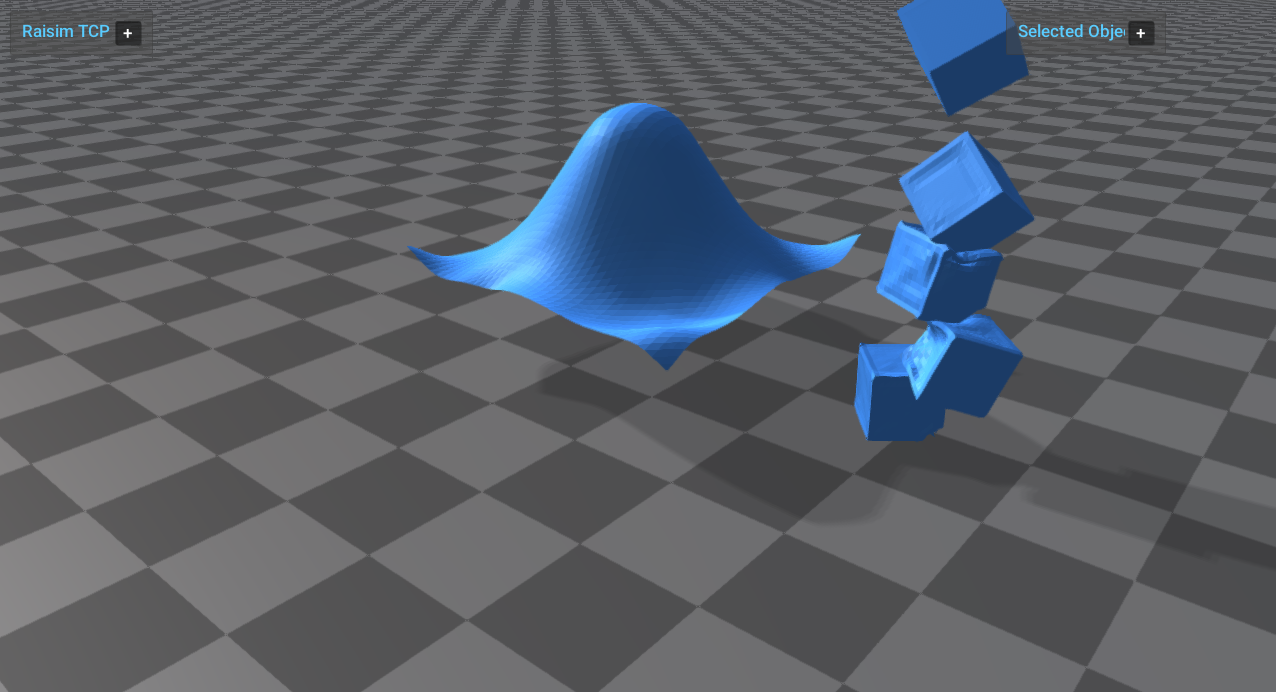
Drapes a soft cloth over a raised static sphere and, to the side, builds a stack of randomly oriented deformable cubes from OBJ meshes. All cubes use resampled surface particles with automatically generated internal struts, so they share the same volumetric behavior. On the other side of the cloth, a tilted block of soft rubber, an elastic solid, drops onto the ground.
Use this example as the starting point for soft-body setup. It shows explicit cloth topology and deformable-object construction from closed OBJ meshes. See Deformable Objects.
Target
CMake target: deformable_objects.
Run
Run the build-tree executable:
./build-examples/examples/deformable_objects
On Windows, run deformable_objects.exe instead.
This example uses RaisimServer. Start rayrai_tcp_viewer and connect to port
8080. The simulation starts once a viewer connects and the example exits when
the viewer disconnects.
Details
Demonstrates
World::addDeformableClothwith explicit vertices and triangle indices.Demonstrates OBJ particle generation and automatic internal struts.
Demonstrates an elastic solid: a filled OBJ mesh with a
youngsModulus(50 kPa, Poisson’s ratio 0.45) is cut into tetrahedra, so the block bounces, bulges and recovers like a rubber block.Generates deterministic random cube orientations at startup, so repeated runs show the same pile while still exercising non-axis-aligned contacts.
Uses
MeshParticleOptions::spacingso RaiSim resamples the mesh surface and builds a dense particle/sphere contact proxy instead of relying only on the raw OBJ vertices. During mesh loading, RaiSim also raises the deformable collision radius to at least0.58 * spacingso the generated spheres cover the surface without particle-scale holes.Uses
distanceCompliance,bendComplianceandairDragfor the cloth, anddistanceCompliance,dampingand internal struts for the mesh objects.Tunes the cloth to be highly deformable, with high bend and stretch compliance so it visibly sags and wraps around the sphere.
Uses identical mesh settings for every cube and dedicated
ground/deformable_cubeanddeformable_cube/deformable_cubematerial pairs.Keeps the generated cloth and cube particle counts moderate so the example remains interactive while still showing visible deformation.
Writes temporary closed cube OBJ files to the system temporary directory at startup and removes them on exit, so no extra mesh asset is required.
Construction modes
The example covers:
Cloth: user-provided vertices and triangle indices define a sheet. This is the right model for flags, hanging cloth, and thin surfaces.
Mesh object: particles are generated from a closed OBJ mesh and connected with internal struts. This is the starting point for deformable objects that should compress and spring back.
Elastic solid: a closed OBJ mesh is filled with particles and cut into tetrahedra with the elasticity of a material of given Young’s modulus and Poisson’s ratio. Use it when the response should follow a real material.
Material parameters
The material controls the XPBD/PBD response:
distanceCompliancecontrols stretch resistance.bendComplianceis the inverse of the bending modulus of cloth-like surfaces; the cloth uses1e3(a bending modulus of 1e-3 N m).airDragdamps the cloth’s motion through the air, anddampingdamps the vibration of the cubes’ material.distanceCompliancealso controls the elastic response of the mesh-based cubes in this example.
Lower compliance means stiffer constraints. More particles or lower compliance make each step more expensive, so start performance comparisons at a lower resolution.
The cloth in this example uses deliberately soft values so it visibly sags and
wraps over the raised sphere. The mesh-based deformable cubes are stacked to
the side so they do not hide the cloth-sphere interaction. The cube material
uses internal struts and stiffness-proportional damping so the dropped cubes
deform, settle, and recover. The example sets the cube collisionRadius from the requested
particle spacing. For a stiffer fabric, reduce distanceCompliance and
bendCompliance or increase the solver iteration count.
Visualization
This example uses RaisimServer. Start rayrai_tcp_viewer before running it:
# Terminal 1
./build-examples/examples/rayrai_tcp_viewer

# Terminal 2
./build-examples/examples/deformable_objects
The viewer receives the deformable topology and vertex updates through the server stream.