
RaiSim vs Newton
At the recorded hardware prices, RaiSim delivers about 2× or more physics performance per dollar at every scale measured for both engines. With 1–64 worlds, the advantage grows to 9.89–253.51× across ANYmal and Strandbeest with independent random actions: about 10× or more in both.
The gap is largest at smaller, practical batch sizes, where fast simulation supports frequent policy updates without waiting to fill a massive batch.
- Fast from one environment. In the random-action ANYmal and Strandbeest benchmarks below, one CPU worker is 95.77× and 13.43× faster, respectively, than Newton on the GPU. At 64–256 environments, RaiSim still delivers 1.38–14.26× higher throughput. It scales efficiently without needing a massive batch to become competitive.
- Update the policy sooner. Rollout-based learners such as PPO collect experience before updating. Increasing that collection batch to fill a GPU can delay the next update. RaiSim's small-batch speed lets you choose rollout size for the learning algorithm and update frequently, rather than for GPU occupancy.
- Handle uneven workloads. Different robots, contacts, resets, and solver work make environments take different amounts of time. Independent CPU worlds can be scheduled separately; divergent GPU work and batch synchronization can leave resources waiting. This makes CPU execution a flexible fit for heterogeneous tasks. See CUDA's control-flow guidance and MJWarp's batch solver behavior.
Choose environment count by time per policy update and time to target reward. The results below measure physics throughput; training speed also depends on rollout scheduling, data transfers, inference, and optimization.
The primary results below use random targets refreshed every ten physics steps. At 4,096 worlds, RaiSim provides 3.40× / 2.04× Newton's FPS/USD for ANYmal / Strandbeest, using $339.99 CPU / $899.99 GPU price assumptions. The GPU costs 2.65× as much as the CPU. Costs are component-only; the GPU also requires a host. These measurements include random target generation, updates and physics, and exclude policy inference, observations, rewards and episode resets.
Prices checked 15 November 2026: 265K $339.99, a recent Newegg advertised-price scenario from an index crawled last month; the direct CPU listing is now out of stock, so this is not a verified currently buyable quote. RTX 5070 $899.99 comes from the new MSI Ventus listing sold/shipped by Newegg, shown with Add to cart. That board is a pricing proxy for the measured RTX 5070. Tax, host system, RAM, motherboard, cooling, energy and licensing are excluded; the GPU also needs a host CPU. Prices are editable in the interactive report.
Random-actuation performance per USD
This workload changes each environment's control targets independently every ten physics steps, instead of holding a standing pose or a constant crank speed. It measures random action generation, target updates and physics, with a CPU worker barrier at each control interval and ordered GPU graph execution. It does not include a learned policy, observations, rewards, episode resets or rendering, so it is not a full RL-training throughput measurement. Each control transition contains ten physics steps: divide the reported physics FPS/USD by 10 for control transitions/s/USD.
- ANYmal: 12 joint-position targets, sampled uniformly within ±0.15 rad of the nominal pose, with position gain 200 and damping 10. Actions update every 20 ms.
- Strandbeest: the single actuated crank's velocity target varies by ±25% around 2π rad/s, with damping 200. The linkage joints remain passive. Actions update every 10 ms.
- Seed 20261115, keyed by environment, control interval and joint. CPU and GPU targets use the same float32 hash-to-action calculation and canonical joint mapping. Cross-engine target checks matched bit-for-bit; serial and multi-threaded RaiSim checks matched final state hashes. Action-on versus action-off checks changed trajectories.
Open the interactive random-action report · Download random-action measurements, per-trial timings, contacts and validation. Component-price assumptions remain $339.99 CPU / $899.99 GPU, with the availability limitations described above. Higher FPS/USD is better; missing CPU results are unmeasured.
ANYmal with random actions
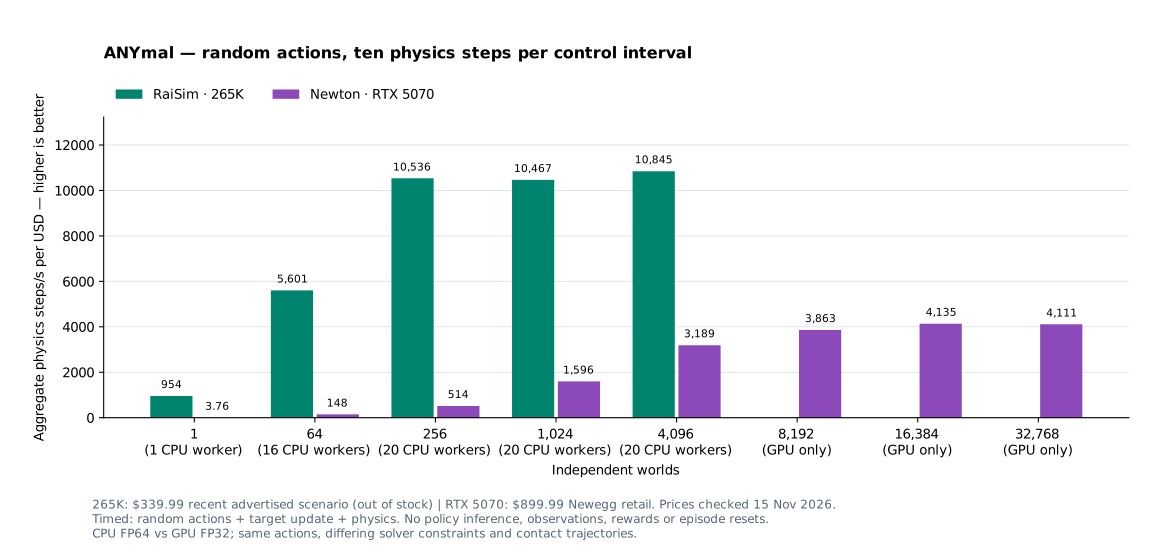
| Worlds | CPU workers | RaiSim FPS/USD | Newton FPS/USD | RaiSim / Newton FPS-per-dollar |
|---|---|---|---|---|
| 1 | 1 | 954.41 | 3.76 | 253.51× |
| 64 | 16 | 5,600.58 | 148.35 | 37.75× |
| 256 | 20 | 10,535.55 | 514.19 | 20.49× |
| 1,024 | 20 | 10,466.75 | 1,596.15 | 6.56× |
| 4,096 | 20 | 10,845.10 | 3,188.73 | 3.40× |
| 8,192 | — | Not measured | 3,862.81 | — |
| 16,384 | — | Not measured | 4,134.67 | — |
| 32,768 | — | Not measured | 4,111.08 | — |
Strandbeest with random actions
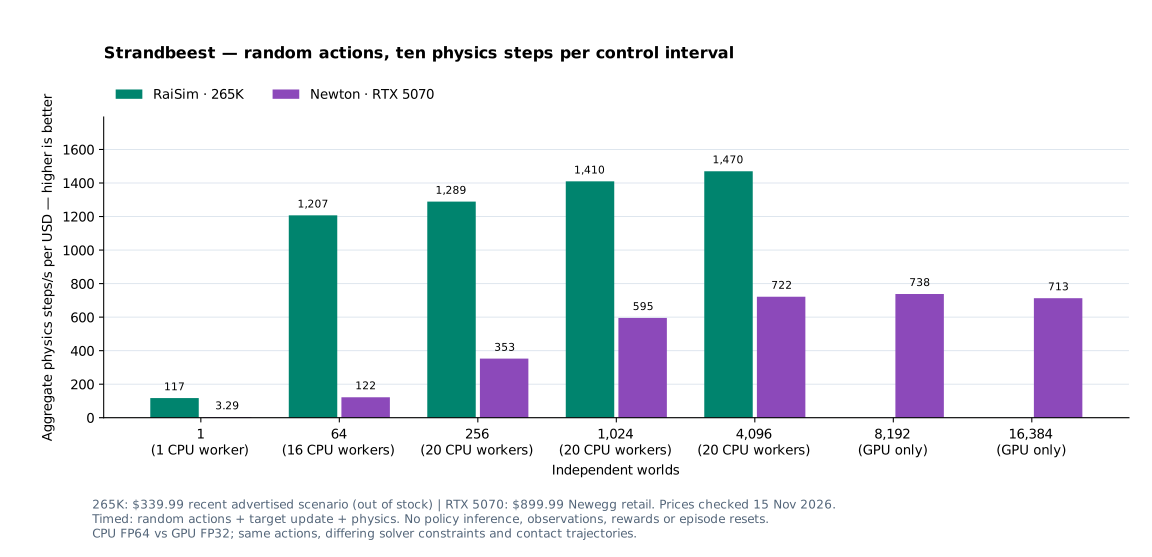
| Worlds | CPU workers | RaiSim FPS/USD | Newton FPS/USD | RaiSim / Newton FPS-per-dollar |
|---|---|---|---|---|
| 1 | 1 | 117.02 | 3.29 | 35.56× |
| 64 | 16 | 1,207.31 | 122.08 | 9.89× |
| 256 | 20 | 1,289.24 | 352.62 | 3.66× |
| 1,024 | 20 | 1,410.19 | 595.12 | 2.37× |
| 4,096 | 20 | 1,470.17 | 721.71 | 2.04× |
| 8,192 | — | Not measured | 737.88 | — |
| 16,384 | — | Not measured | 712.86 | — |
Random-action validation and limits
All 25 benchmark cases passed the finite-state, contact, timing and target-sequence checks. GPU cases reported zero solver overflow; all Strandbeest closure gaps were below 1 mm. At 4,096 worlds, trajectory-mean contacts/world were 2.683 / 2.336 for ANYmal (RaiSim / Newton) and 0.945 / 0.696 for Strandbeest. These differences are retained in the dataset rather than treated as equal contact work.
Both engines warm with nominal actions: 1,100 ANYmal steps or 100 Strandbeest steps. Each timed trial then restores the post-warmup ANYmal state or the initial Strandbeest state, resets solver warm starts and the action counter, and replays the same action sequence. Trials contain 5,000 ANYmal steps or 3,000 Strandbeest steps at every world count. Results use medians of three trials, except single-world RaiSim uses seven. No trials are discarded. Processes run serially; CPU workers are pinned, with one independent world per environment and no engine-internal threading.
An extra untimed replay measures trajectory-mean contacts and checks finite states, solver overflow and Strandbeest closure gaps. RaiSim closure gaps and finite states are sampled at ten-step boundaries; Newton gaps/overflow are checked every physics step, and its finite state is checked at the end. These are different validation sampling rates, not a claim of identical accuracy. Full trial times and contact means are included in the downloadable records. Equal action targets do not imply equal contact trajectories, because the solvers, precision and constraint formulations differ.
The earlier fixed-target numbers use a different driver protocol (no CPU control-interval barrier and varying CPU trial horizons). Differences between the two workloads therefore include synchronization, action-update overhead and changed physics; they do not isolate random actuation cost alone. No episode resets are timed, and no claim is made about policy or full training throughput. The larger-world GPU memory safeguard is unchanged.
Earlier fixed-target measurements
Fixed-target ten-step performance per USD
RaiSim runs on a Core Ultra 7 265K; Newton SolverMuJoCo / MuJoCo Warp runs on an RTX 5070. Each environment has its own world, ground, and robot. At the recorded component prices, RaiSim provides 1.88–192.43× more steps per dollar across all ten paired comparisons. GPU throughput can lead at large batches; CPU performance above 4,096 environments has not been measured here.
Explore throughput and change prices · Download recorded results.
FPS/USD is aggregate world physics steps/s divided by the full component price: $339.99 for the CPU and $899.99 for the GPU. The GPU costs 2.65× as much; at 4,096 worlds, RaiSim retains 1.88× / 2.08× the FPS/USD for ANYmal / Strandbeest.
ANYmal standing
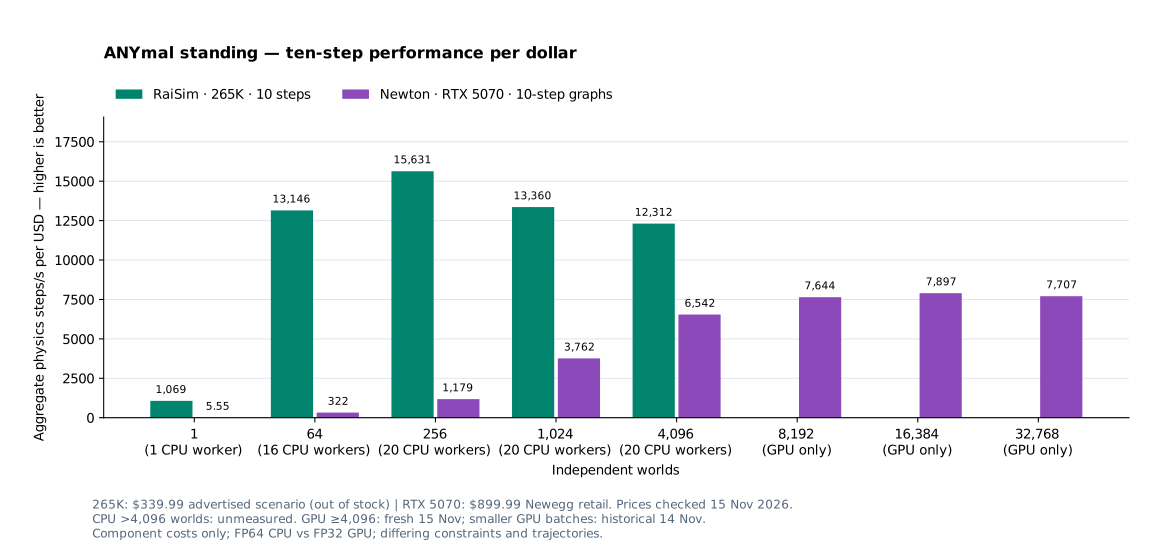
| Worlds | CPU workers | RaiSim FPS/USD | Newton FPS/USD | RaiSim / Newton FPS-per-dollar |
|---|---|---|---|---|
| 1 | 1 | 1,068.60 | 5.55 | 192.43× |
| 64 | 16 | 13,146.06 | 321.84 | 40.85× |
| 256 | 20 | 15,630.98 | 1,178.54 | 13.26× |
| 1,024 | 20 | 13,360.45 | 3,761.72 | 3.55× |
| 4,096 | 20 | 12,312.24 | 6,542.08 | 1.88× |
| 8,192 | — | Not measured | 7,644.33 | — |
| 16,384 | — | Not measured | 7,897.44 | — |
| 32,768 | — | Not measured | 7,706.77 | — |
Strandbeest
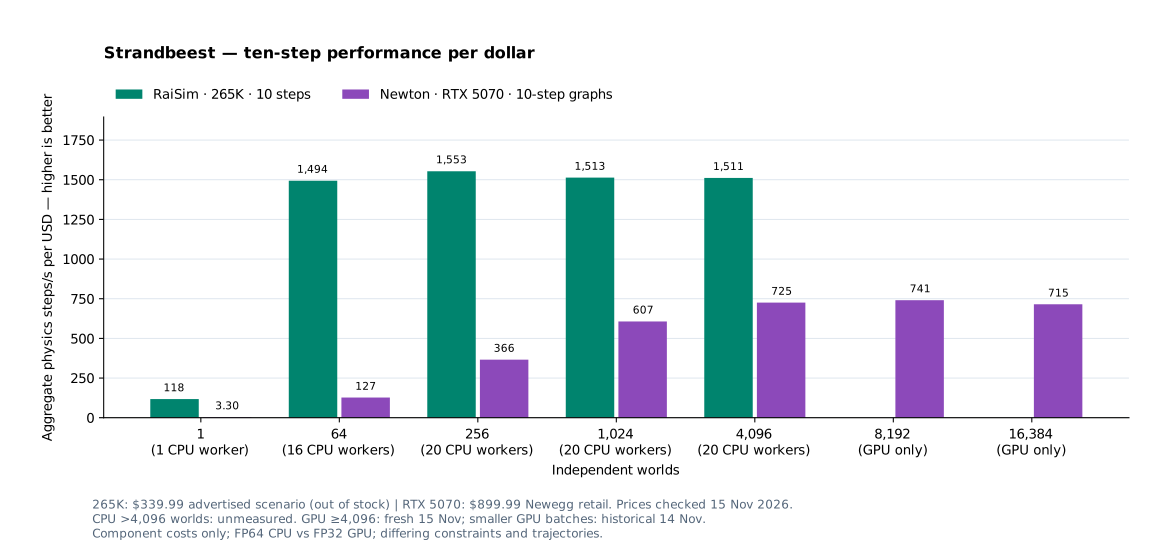
| Worlds | CPU workers | RaiSim FPS/USD | Newton FPS/USD | RaiSim / Newton FPS-per-dollar |
|---|---|---|---|---|
| 1 | 1 | 117.60 | 3.30 | 35.67× |
| 64 | 16 | 1,493.57 | 127.10 | 11.75× |
| 256 | 20 | 1,553.38 | 365.93 | 4.25× |
| 1,024 | 20 | 1,513.19 | 606.58 | 2.49× |
| 4,096 | 20 | 1,511.11 | 725.41 | 2.08× |
| 8,192 | — | Not measured | 740.77 | — |
| 16,384 | — | Not measured | 714.88 | — |
Scaling beyond 4,096 worlds
Scaling beyond 4,096 worlds
Newton supports more than 4,096 environments; this was a benchmark sweep endpoint, not a solver limit. Fresh runs retain the same ten-step graphs, solver parameters, precision, time horizons and three-trial protocol. Larger batches can increase aggregate throughput while reducing steps/s per environment. Once the GPU is saturated, additional environments mainly consume memory and can reduce throughput.
- ANYmal: best measured FPS/USD was 7,897.44 at 16,384 worlds, 1.21× the fresh 4,096-world value. Largest tested batch: 32,768, sampled process GPU-memory peak 2,438 MiB.
- Strandbeest: best measured FPS/USD was 740.77 at 8,192 worlds, 1.02× the fresh 4,096-world value. Largest tested batch: 16,384, sampled process GPU-memory peak 5,770 MiB.
The fresh 4,096-world throughput is within 1.1% of the previous historical value for both robots. Among the fresh ANYmal trials, FPS/USD ranged from 7,792.52–7,898.03 at 16,384 worlds and 7,603.89–7,715.17 at 32,768 worlds. The small decline at 32,768 worlds is an observed result, not proof of a universal optimum. The downloadable records include all three trial timings for every fresh case.
All reported fresh cases passed finite-state, constraint-quality and zero-overflow checks. Sampled GPU-memory peaks come from periodic nvidia-smi process readings, not allocator-exact peaks. The RTX 5070 has 12 GB VRAM; the sweep avoids doubling a workload once sampled usage exceeds 5,000 MiB because it could approach or exceed available VRAM. This safeguard does not establish a maximum supported world count.
RaiSim was not measured above 4,096 worlds in this comparison; missing CPU values are not zero or extrapolated. GPU results through 1,024 worlds remain historical 14 November measurements; GPU results at 4,096 and above are fresh 15 November runs. Download full scaling measurements, validation and GPU-memory samples.
Hardware prices, measurement protocol, and limits
Prices checked 15 November 2026: 265K $339.99, a recent Newegg advertised-price scenario from an index crawled last month; the direct CPU listing is now out of stock, so this is not a verified currently buyable quote. RTX 5070 $899.99 comes from the new MSI Ventus listing sold/shipped by Newegg, shown with Add to cart. That board is a pricing proxy for the measured RTX 5070. Tax, host system, RAM, motherboard, cooling, energy and licensing are excluded; the GPU also needs a host CPU. Prices are editable in the interactive report.
Protocol and limits
CPU workers integrate each world ten times before visiting the next world. Newton uses graphs of ten GPU steps. Workers own disjoint world ranges and are CPU-pinned; integration inside each world is single-threaded. Worker counts are recorded configurations, not a demonstrated optimum. Setup, warmup, validation and external policy computation are excluded. Time steps are 2 ms for ANYmal and 1 ms for Strandbeest. CPU throughput uses median elapsed wall time; single-world cases have 21 trials across three processes and multiworld cases have 10 across two, except ANYmal 4,096/20 scores six of ten after the prespecified first-two-per-process exclusion. Processes ran serially; timed horizons vary with world count.
RaiSim CPU measurements are from 15 November 2026 and use FP64. Newton GPU measurements use FP32: counts through 1,024 are from 14 November, and counts from 4,096 onward were rerun on 15 November for the larger-world sweep. The scenes/controllers were matched, but solvers, constraint formulations and trajectories differ; these ratios do not compare identical numerical work. ANYmal has four contacts/world. Historical Strandbeest trajectory means are approximately 0.959 contacts/world for RaiSim and 0.686–0.700 for Newton; the current RaiSim ending count of one/world is a different statistic. RaiSim merges fixed links (74 bodies), while Newton retains them (92). All 18 CPU scheduling cases matched final state hashes and contacts against one-step scheduling, with six extra partial-block/uneven-range checks. The tables retain the ten primary CPU comparison cases and add the measured larger GPU batches.
For the single-threaded CPU comparison, see RaiSim vs MuJoCo.