Rayrai Example: Forest
Overview
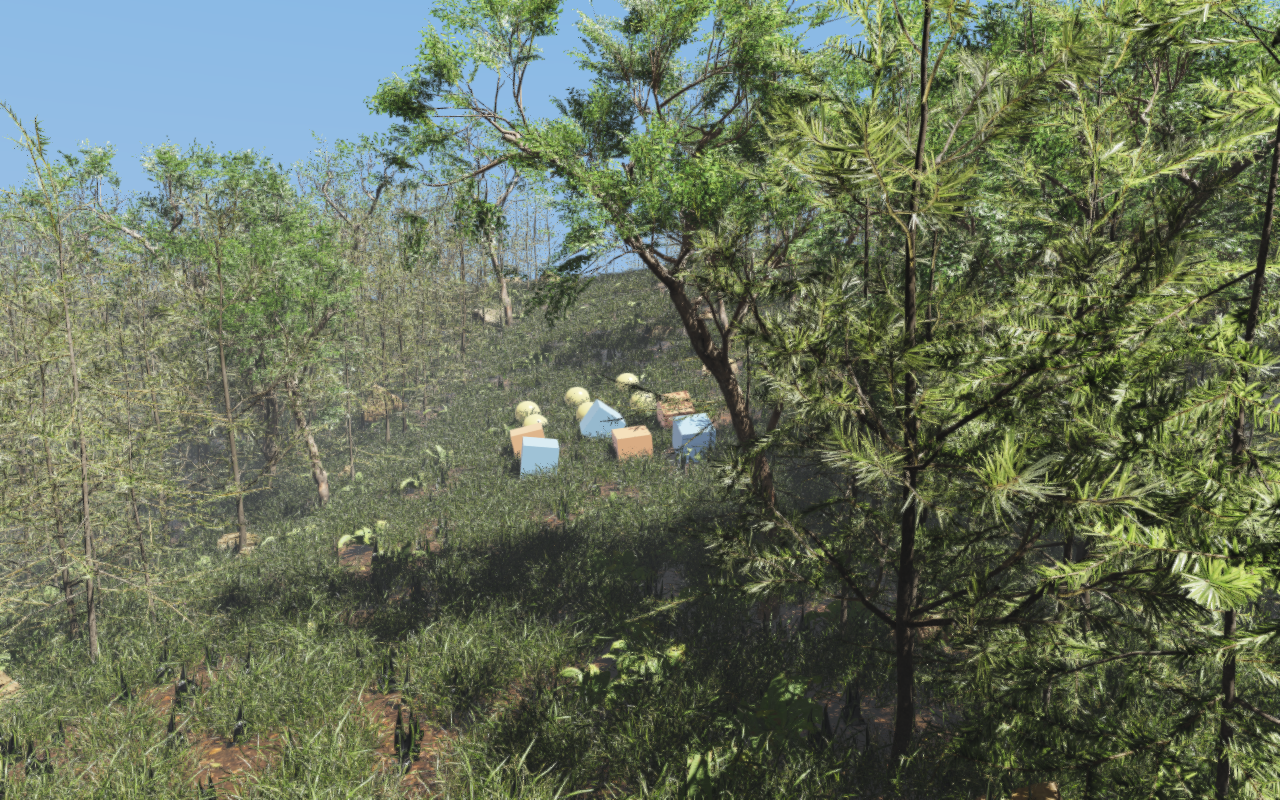
Renders an 80 m × 80 m rolling heightmap covered by instanced Poly Haven
vegetation: 1,888 trees, 61,200 ground-cover instances, and 180 mossy rocks.
One hundred dynamic props (crates, balls, capsules, and spheres dropped onto
tree crowns) fall onto the same heightmap that places the plants. Ground cover
is visual-only. Trees and rocks collide through static collision proxies
loaded from each asset’s model.rasset.
Target
CMake target: rayrai_forest (C++20).
The example needs rayrai 2.7.0 or newer. On Linux, the 2.7.0 package can throw
std::bad_alloc from InstancedVisuals::addInstances with newer libstdc++
versions; v2.8.0 fixes it (see Changelog: v2.8).
Run
Run the build-tree executable:
./build-examples/examples/rayrai_forest
./build-examples/examples/rayrai_forest --assets /path/to/forest
On Windows, run rayrai_forest.exe instead. The asset directory defaults to
rsc/forest in the checkout used to configure the build. Copy that
directory and pass --assets when you move the executable. The example
renders in process and does not need rayrai_tcp_viewer.
Loading the forest from a scene file
The same world is saved as rsc/forest/rayrai_forest.rscene.
Rayrai Example: Forest From .rscene builds it from that file with
raisim::World(path), shown by a RayraiWindow, instead of placing it in
C++, and simulates identically. The reader is new in v2.8.0, and the
RayraiWindow display needs v2.8.2 (not yet released);
.rscene File describes the file format.
Loading and caches
Meshes load asynchronously while a progress bar across the top of the window
counts the finished assets; physics starts once loading completes. The first
launch builds mesh LODs for the high-detail plants and takes several seconds
longer (about 10 s in total on a 20-thread desktop). Rayrai saves the prepared levels beside each model as
rayrai_cache_model.gltf.lods, and the prepared geometry and import
description of the three trees as .rgeo and .rimp files, and reads them
on later launches, which then import no tree at all. When the
asset directory is read-only, the cache goes to the system temporary directory
instead. Set RAYRAI_ASYNC_LOD_CACHE_DIR to choose a cache directory. The
cache files are ignored by Git and can be deleted at any time.
Instance transform records are also cached for single-part foliage batches with up to 32,768 instances, including the 18,000-instance grass batches. The cache reuses the original computed values across scene and shadow selections and is invalidated by instance or distance-fade edits. Each 18,000-instance batch uses about 1.37 MiB for these records, plus validity flags. Geometry, draw order, shader arithmetic and quality settings stay the same. This reduces CPU preparation work.
When collecting cached records into draw batches, the renderer copies complete records directly into the retained batch bytes. Compile-time size and member offset checks ensure identical source and destination layouts. This removes an intermediate record without changing floating-point arithmetic or cache storage; invalidated records still follow the original computation path.
For individually selected foliage LODs, the renderer also reuses the exact color-LOD choice across passes with identical camera and LOD inputs. Each shadow cascade retains its own visibility tests and shadow LOD choice. Camera, instance, bounds, wind and LOD-policy changes invalidate this cache. It stores one byte per rendered instance and mesh part and keeps the original arithmetic and thresholds.
On 64-bit hosts, ground-cover groups with 8,192–32,768 visible instances sort packed depth keys and instance IDs in the existing scratch vectors. This avoids repeated depth loads and conversion while preserving the exact final depth/ID ordering, including tied depths and signed zero. Other sizes and 32-bit hosts keep the existing ID-based radix sort. For packed groups, unsorted IDs, IDs above the 32-bit range and NaNs use the comparison-sort path. The CPU sorting test covers both size boundaries and arbitrary float patterns; the GPU preparation test also checks fully visible groups for exact draw order, color and depth. This reduces sorting work.
Visibility diagnostics for meshes with several parts count each instance once across overlapping LOD groups. Batches with up to 1,024 candidate instances (after the render-count limit, before culling and stride) use byte flags, including the forest’s tree batches; larger batches retain packed flags. This adds at most 1 KiB of byte flags per eligible batch and preserves exact counts and draw records. The preparation test covers both sides of the boundary, shrink/regrow, render limits, strides and cached selections. This reduces CPU bookkeeping.
Details
Uses one 161 × 161 heightmap for both collision and plant placement, with a fixed-seed scatter.
Adds the tree and rock collision proxies with
raisim::Rasset::loadandRasset::addStaticColliders.Renders ten plant types and six rock shapes as
InstancedVisualswith automatic mesh LOD, projected-size thinning, foliage shadow LOD, per-type wind, and shadows enabled for every batch.Uses the
Highpreset with ACES tone mapping, 4× MSAA, three directional shadow cascades out to 80 m, and clear weather with a distance haze.Integrates eight 2 ms physics steps per rendered frame.
Tests
The forest checks live in the RaiSim source repository (test/examples) and
are registered when that repository is configured with -DRAISIM_TEST=ON
next to this checkout. They cover terrain placement and physics, the
.rscene reader, and asset integrity (needs Python 3); with
-DRAISIM_RAYRAI_TEST=ON they also cover the loading overlay.
-DRAISIM_FOREST_GPU_TESTS=ON adds rendering smoke tests and foliage-shadow
checks, which need a display and OpenGL. FOREST.md lists the build and
ctest commands. The scatter regression compares transform fields
bit-for-bit with the original placement algorithm. The Rayrai
rayrai_foliage_preparation_test also compares cached and uncached GPU
instance records, color bytes and depth bytes exactly at the forest batch
size and cache boundaries, including edits and cache re-enabling. Detailed
foliage checks include exact index geometry across color and shadow passes
with changing cameras and LOD policies. The CPU
rayrai_foliage_color_lod_cache_test covers reuse, all invalidating inputs
and floating-point boundaries.
The separate rayrai_foliage_color_lod_cache_gpu_test runs the color-cache
byte comparisons via rayrai_foliage_preparation_test --color-lod-cache.
The assets are from Poly Haven under CC0; see
rsc/forest/ATTRIBUTION.md. examples/src/rayrai/worlds/FOREST.md
documents asset preparation, the build and test commands, and the LOD cache.