
Server Example: Robotiq Cloth Fold
Overview
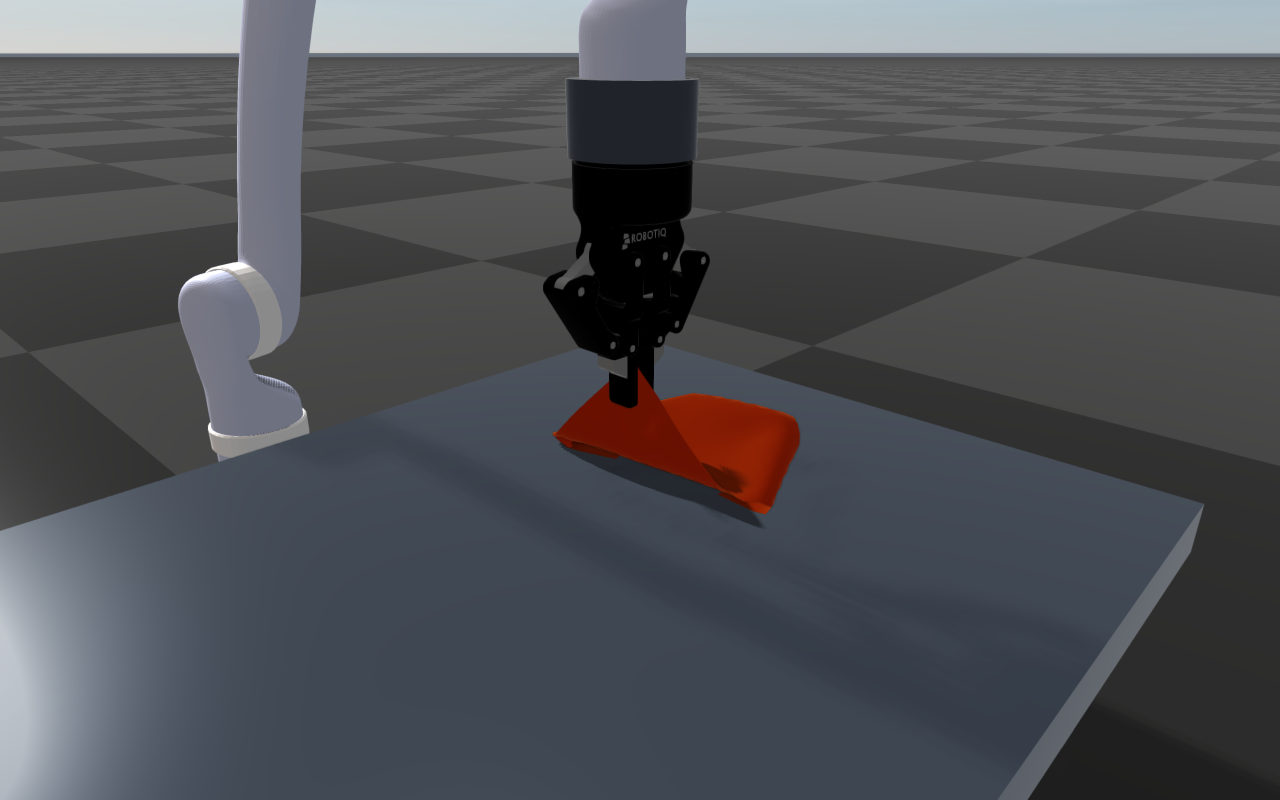
A fixed-base Kinova arm with a wrist-mounted Robotiq 2F-85 folds a square cloth in half on a table. The pads hold one corner of the hanging cloth. The arm moves across the cloth while lowering it, so the lower half lies down on the table, then swings the held corner over onto the corner that touched down first. It holds the fold, unfolds the cloth along the same path, lifts it back up, restores the starting state, and repeats the 15-second cycle. All motion comes from joint PD control and physical contacts.
The cloth is a deformable object in contact with the gripper pads, the table and itself (see Deformable Objects). It is solved together with the arm, the pads and the table (World::setMonolithicDeformables()), so the squeeze of the pads and the weight of the cloth act on the arm within the same step. The arm and gripper are the model of Server Example: Robotiq Gripper Mimic.
Target
CMake target: robotiq_cloth_fold.
Run
Run the build-tree executable and connect rayrai_tcp_viewer to port 8080:
./build-examples/examples/robotiq_cloth_foldOn Windows, run build-examples/bin/robotiq_cloth_fold.exe instead. The example discovers its resource folder relative to the executable or working directory. Normal RaiSim license discovery applies; use --activation-key /path/to/activation.raisim for an explicit license. --port N changes the server port. The example repeats until interrupted; --cycles N stops it after N cycles. --headless runs two cycles without a server and prints whether each one succeeded.
Details
- Loads
rsc/robotiq_2f85/kinova_robotiq.urdf. Only the six arm joints androbotiq_85_left_knuckle_jointhave PD gains; the five gripper followers stay passive under their URDF<mimic>constraints. - The cloth is a 0.2 m square of 19 x 19 particles weighing 20 g, with nearly inextensible edges, a bending modulus of 5e-5 N m, and self-collision, so the folded half rests on the lower half. Its elastic constraints are projected in 10 sweeps of each 1 ms step. Its particles collide as 6 mm spheres, close enough that the 4 mm thick pads cannot slip between them.
- The pads clamp the corner face-on. The knuckle target lies beyond the closing angle at which the pads meet the cloth, so the knuckle PD squeezes it.
- Friction coefficients: 0.8 between the pads and the cloth, 0.6 between the table and the cloth, and 0.3 between two layers of cloth. The folded half slides into place over the lower half instead of dragging it along.
- The waypoints are positions of the gripper's
grasp_frame, solved withArticulatedSystem::solveIK()on a second, kinematics-only copy of the arm. The fold is planned when it begins: the cloth folds about the line half a diagonal from the corner that touched down, wherever that corner landed. The pads' lower edges circle that line at 8 cm, a little less than the cloth between them and the fold, because a taut upper half would pull the lower half across the table. - A quintic time scaling covers each phase, and a cubic spline through the joint waypoints keeps the arm moving through them without stopping.
- Each cycle checks that both pads held the cloth throughout, that the lower corner rested on the table when the fold began, that the held corner then lay within 8 cm of the lower corner while the lower corner slid less than 2 cm, and that the cloth hung clear of the table at the end.
- After each cycle the example restores a checkpoint of the settled initial world, including robot and cloth state and solver history.
- Controller updates run inside the RaisimServer world mutex and follow simulation time, so viewer pause and queued single-step pause the sequence.
- The combined arm and gripper model reuses the bundled BSD-licensed Kinova and Robotiq descriptions and meshes; see the license files in
rsc/robotiq_2f85andrsc/kinova.