
Rayrai Example: City
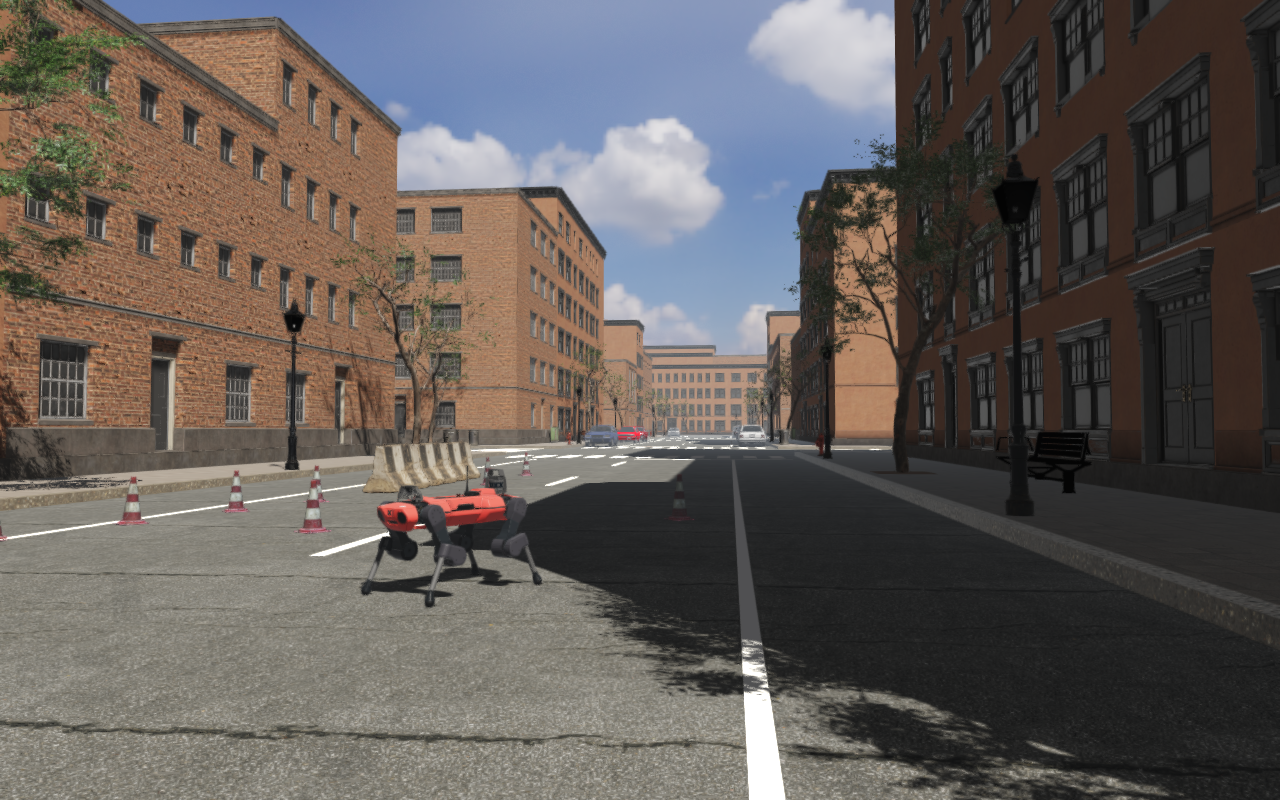
The parked cars in this scene are licensed under CC BY 4.0 and credited in Asset Credits.
Overview
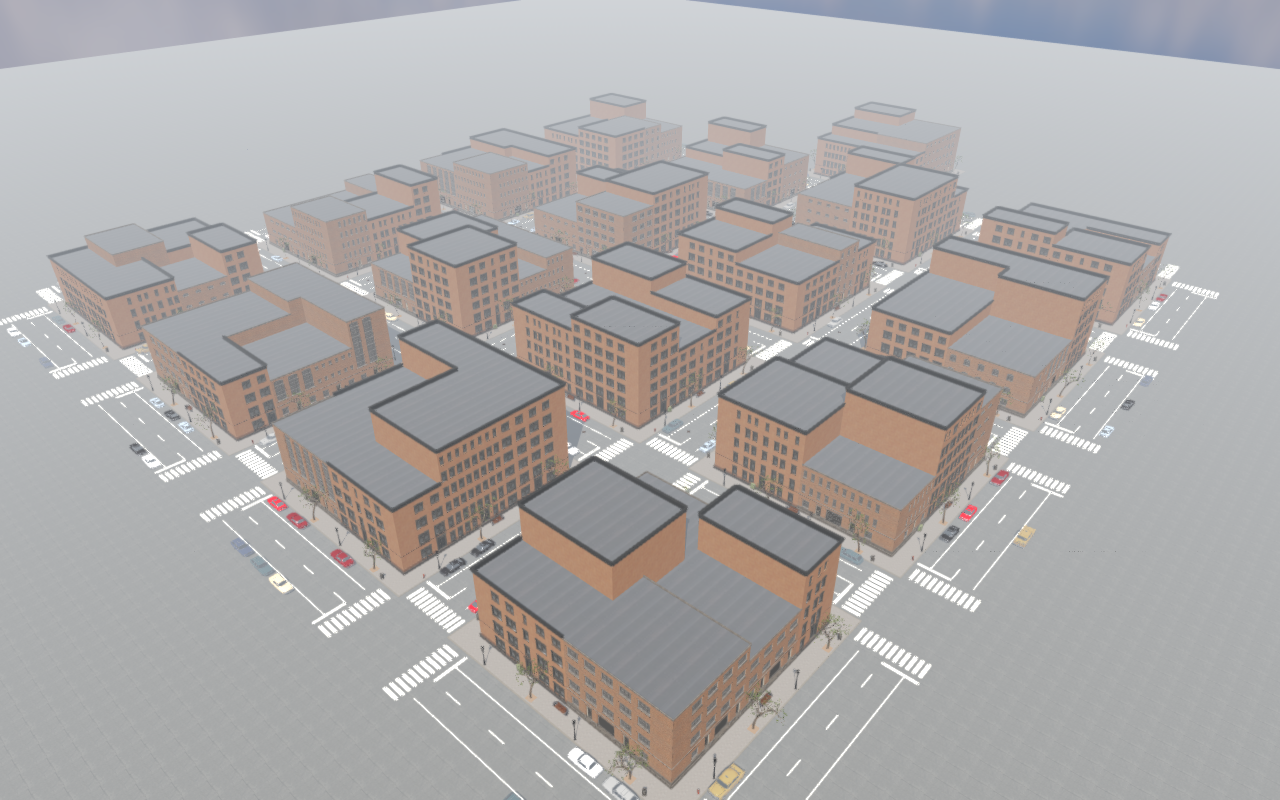
A photoreal city of 17 blocks and 105 buildings, built only from free assets and stored as a RaiSim Engine scene, rsc/city/rayrai_city.rscene. An ANYmal C quadruped stands on the street next to roadworks, held by joint PD control. The example is short:
auto world = std::make_shared<raisim::World>(
  exampleRscPath(argv[0], "city/rayrai_city.rscene"));
// The .rscene reader creates no articulated systems, so the robot is added here.
addStandingAnymal(*world, exampleRscPath(argv[0], "anymal_c/urdf/anymal.urdf"));
raisin::RayraiWindow viewer(world, 1280, 800);  // applies the scene
raisim::World(path) creates the ground, sidewalk and building colliders, hidden .rasset colliders for lamps, trees, hydrants, bins, benches, utility boxes, barriers and cars, and eleven dynamic traffic cones. The viewer applies the scene's HDR sky, the sun with two shadow cascades, the render settings, 86 instanced batches (78 facade modules and 8 kinds of street furniture), the 159 parked cars, the baked street and building-shell meshes, and the street-level camera.
Target
CMake target: rayrai_city (C++20). Source: examples/src/rayrai/worlds/rayrai_city.cpp. Like Rayrai Example: Forest From .rscene, it needs the .rscene support of raisim::World and a rayrai whose RayraiWindow applies its world's scene; CMake skips the target when the installed rayrai lacks it.
Run
./build-examples/examples/rayrai_city
./build-examples/examples/rayrai_city --screenshot city.png
./build-examples/examples/rayrai_city --scene /path/to/rayrai_city.rscene
The example finds the scene in the rsc folder that CMake copies next to the executables. --scene loads another file, for example the checkout's rsc/city/rayrai_city.rscene after regenerating it. --screenshot renders in a hidden window without vsync, waits for the assets, lets the robot and cones settle for 90 frames, prints the average frame time of those frames, saves the image and exits. Physics runs eight 2 ms steps per rendered frame once the meshes are loaded; it costs about 1.2 ms of each frame. On an RTX 2070 SUPER at 1280 × 800 with 4× MSAA a frame of the default view takes about 22 ms.
The scene
- Buildings. Each block holds two rows of 18 m deep lots, 9 to 18 m wide. A lot becomes an apartment (four to six floors) or factory building (three to five floors) assembled from 3 m wall modules with matching window and door inserts, a base plinth, a dado band, a cornice over the ground floor, a crown parapet and L-shaped corner pieces at the block corners. Street faces get an entrance (and garages on long factory faces); walls above a lower neighbour get blank party-wall modules. Dark shells behind the facades read as unlit rooms through the glass, and flat roofs cover them.
- Streets. 12 m roads with two lanes and parking, 3.5 m sidewalks with curbs, dashed centre lines, parking-lane lines, zebra crossings, stop lines for right-hand traffic, manholes, lamps, trees with soil pits, hydrants, bins, benches and utility boxes. One block past the last cross street closes the camera's view down the street. The street mesh is split into 3 m cells: rayrai v2.8.0 drops cascade shadows near the camera on large receiver triangles that reach behind it, which a later release fixes.
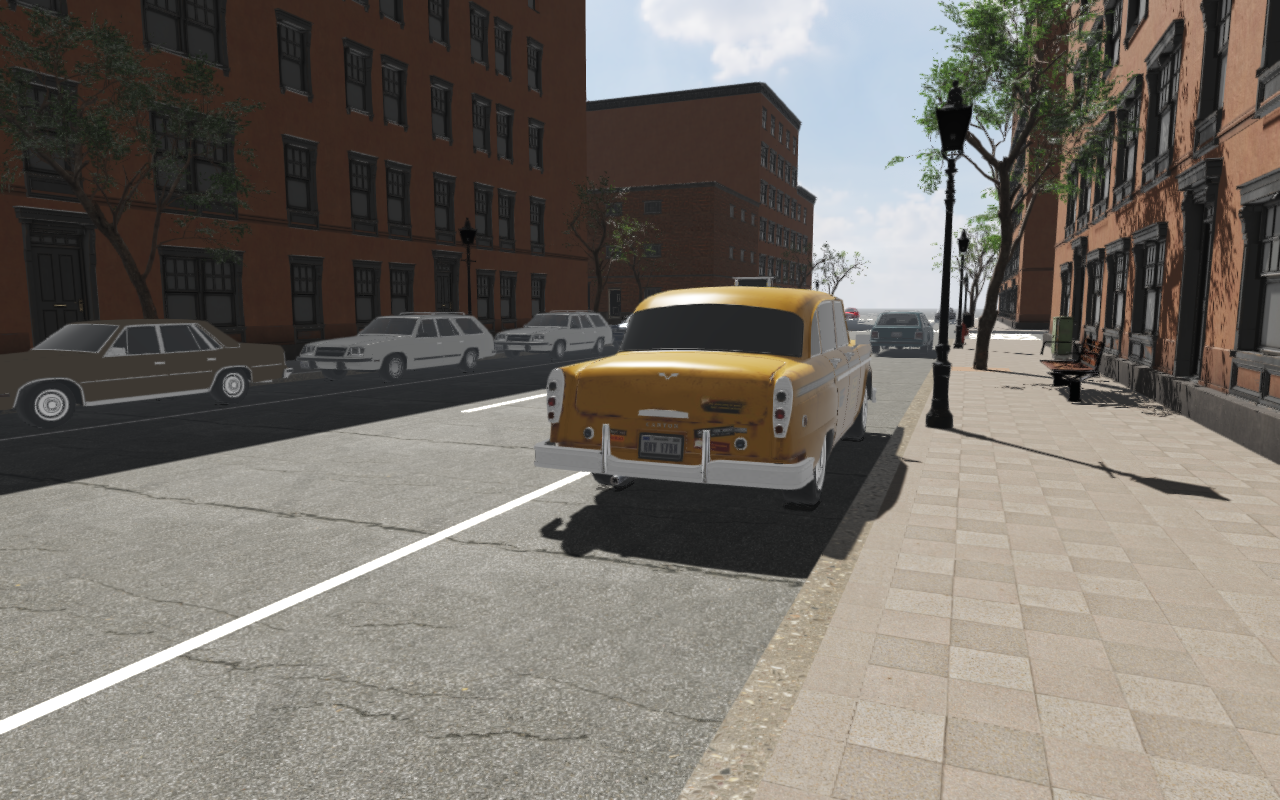
- Cars. 159 parked cars of four fictional-brand models, three of them in three paints, facing the direction of travel. Each is a visible
.rassetobject: a regular visual with a hidden box collider. Instanced batches do not draw the cars' blended glass or plain-coloured paint correctly. - Lighting. The sky is a Poly Haven pure-sky HDR. Its sun disk is clamped and the image turned by 180 degrees so that a shadow-casting directional light, at the measured sun direction, lights the street from behind the camera without counting the sun twice in image-based lighting.
Assets
All assets are free. Poly Haven provides the two facade kits, the street furniture, the ground textures and the sky; BlendKit the photoscanned traffic cone (both CC0). The cars are Daniel Zhabotinsky's models on Sketchfab under CC BY 4.0, credited in rsc/city/ATTRIBUTION.md. The street trees are the forest example's rsc/forest/tree_small_02. The prepared assets occupy about 176 MiB; mesh LOD caches that rayrai writes beside them are ignored by Git.
Three standard-library Python scripts (preparation also needs NumPy, SciPy and Pillow) rebuild everything:
python3 examples/tools/download_city_assets.py /tmp/city
python3 examples/tools/prepare_city_assets.py /tmp/city rsc/city
python3 examples/tools/generate_city_rscene.py rsc/city   # layout only
The Sketchfab downloads need the API token of a free account (https://sketchfab.com/settings/password) in SKETCHFAB_API_TOKEN or ~/.sketchfab_api_token; Poly Haven and BlendKit need none. Preparation splits each facade kit into Z-up modules that share the kit's buffer and textures. The kits model each flat wall as a dense grid (a plain 3 m panel has 4,608 triangles), so flat regions that exactly tile a grid are rebuilt from a few rectangles with the same texture coordinates; this halves the modules' triangles and the frame time without changing the image. The generator lays out the city with a fixed seed and writes the scene, the street mesh and the building-shell mesh.
See .rscene File for the format and Rayrai Example: Forest for the LOD cache and asynchronous loading.