
Rayrai Example: Motor Operating Region
Overview
This example drives the twelve actuators of a fixed-base quadruped rig with random commands and plots, for the motor of every actuator, its operating region and the operating points of the last second in the motor's torque-speed plane. Use it to check that RaiSim keeps every motor inside its region (see Actuators). The commands are actuator torques from an explicit PD controller, sent with setActuatorTorques(), so the region clips all of them.
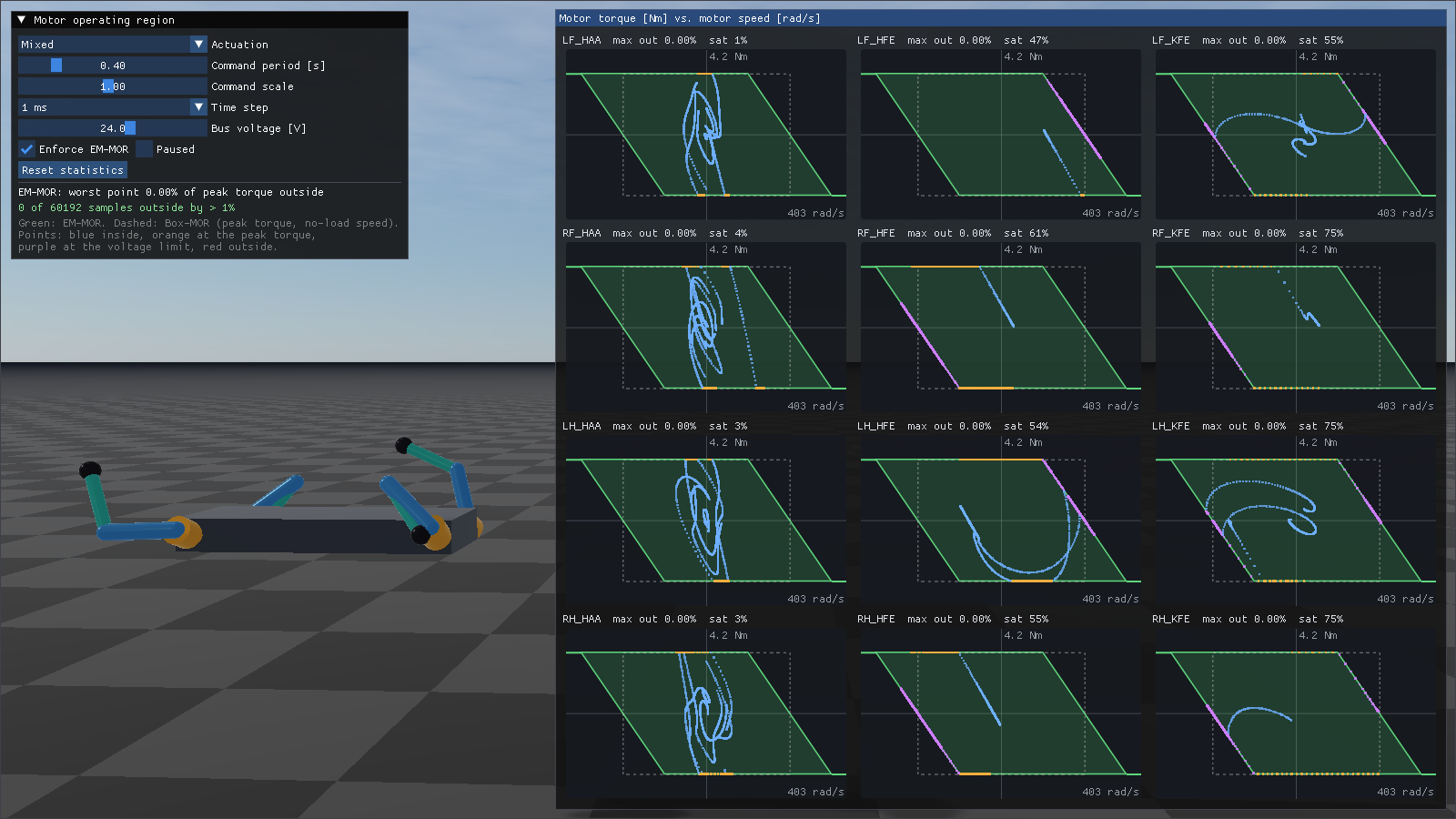
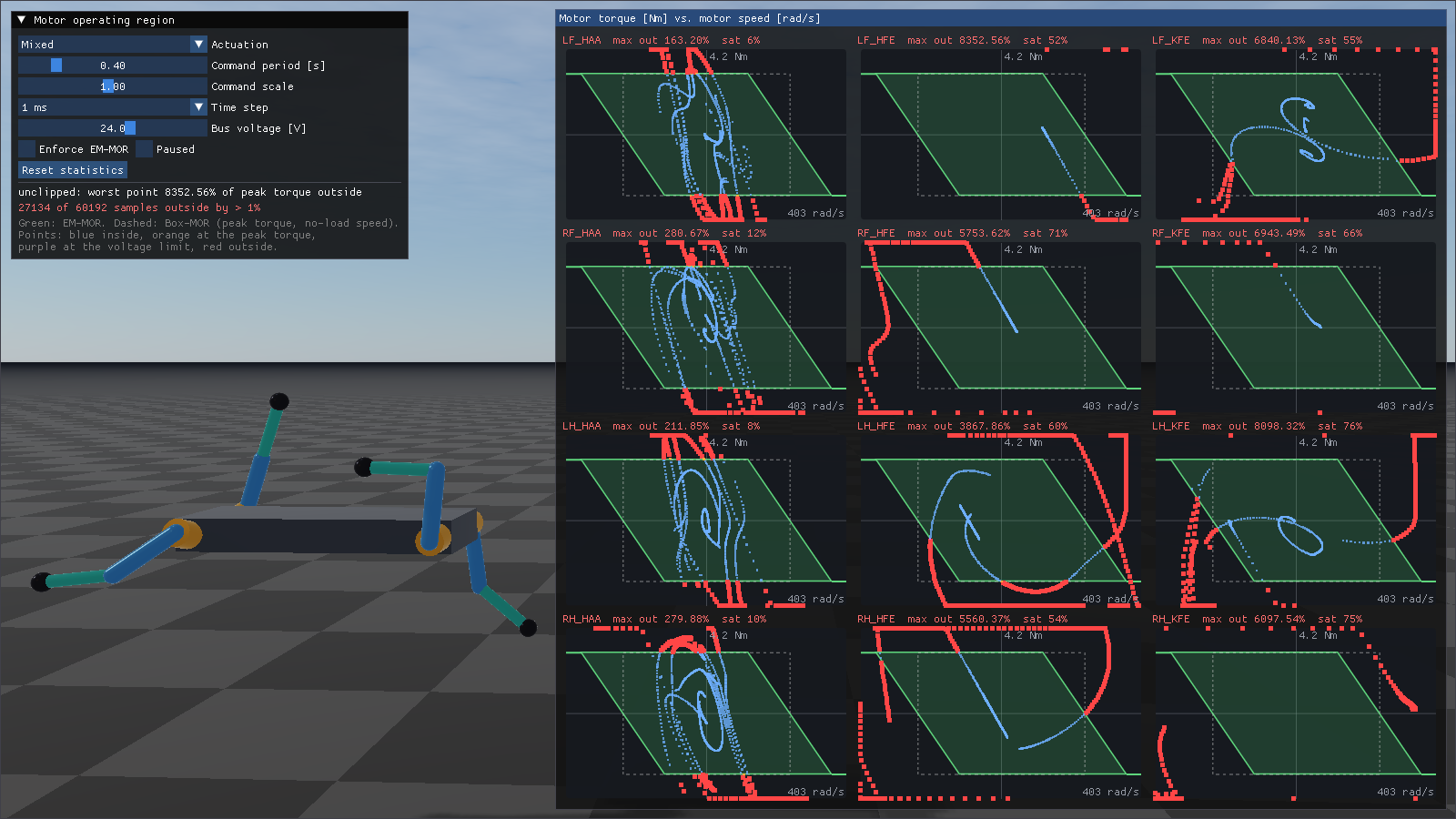
The controller knows nothing about these limits and often commands far more torque than the motors can produce; RaiSim has to clip it. With Enforce EM-MOR unticked, the actuator torques are applied without MOR clipping. Joint effort limits do not clip actuator torques either, so the same commands leave the region far behind; the joint velocity limits of the rig keep the run bounded:
Target
CMake target: rayrai_motor_operating_region.
Run
./build-examples/examples/rayrai_motor_operating_regionOn Windows, use rayrai_motor_operating_region.exe. The example uses the in-process rayrai renderer and does not need a TCP viewer.
The control window sets the random actuation (mixed, position targets, velocity sweeps beyond the no-load speed, or raw torques), its period and scale, the time step (1, 2.5 or 5 ms) and the bus voltage. The Bus voltage slider (6 to 36 V) calls setBusVoltage() for all actuators, and the regions shrink and grow with it. The speed axis never shrinks below the range for the 24 V of the actuator files, so a lower voltage visibly shrinks the region. Enforce EM-MOR calls setMotorOperatingRegionEnforced(), which toggles MOR clipping of the torques sent through setActuatorTorques(); it does not affect the joint effort limits, which apply only to setGeneralizedForce() and the built-in PD controller (the example uses neither). Paused stops the simulation, and Reset statistics clears the counters.
The model
rsc/motorOperatingRegion/quadruped_rig.urdf puts an actuator on every joint. Their models are in the linked files in rsc/motorOperatingRegion/actuators/:
<actuator joint="LF_HAA" file="abduction_actuator.xml"/>
<actuator joint="LF_HFE" file="hound_leg_actuator.xml"/>
<actuator joint="LF_KFE" file="hound_leg_actuator.xml">
  <coupling joint="LF_HFE" ratio="1"/>
</actuator>
All twelve actuators use the same DC motor on a 24 V bus: effort limits (18 Nm and 30 Nm) apply only to setGeneralizedForce() and the built-in PD controller, which the example does not use; they do not limit actuator torques. The URDF velocity limits are 1.5 times the no-load speeds at the joints (60 rad/s for abduction, 36 rad/s for hip and knee). With the operating regions enforced the motors settle near their no-load speeds; without them, nothing else would stop the commanded torques from spinning the joints up until the simulation breaks down.
abduction_actuator.xml: the hip abduction actuator, a motor behind a 6:1 reducer.xml<actuator_model name="abduction_6to1" gear_ratio="6" output_damping="0.01" output_friction="0.2"> <motor resistance="0.4" torque_constant="0.1" velocity_constant="10" bus_voltage="24" peak_torque="3"/> </actuator_model>hound_leg_actuator.xml: the hip and knee actuators, a motor behind a 10:1 reducer. Like in KAIST Hound, both motors sit on the body and the knee reducer's ring gear turns with the thigh, so the knee motor also turns with the hip,. Each knee <actuator>declares that with its<coupling>.xml<actuator_model name="hound_leg" gear_ratio="10" output_damping="0.02" output_friction="0.3"> <motor resistance="0.4" torque_constant="0.1" velocity_constant="10" bus_voltage="24" peak_torque="3"/> </actuator_model>
The actuators are named after their joints: LF_HAA, LF_HFE, LF_KFE and so on (see getActuatorNames()).
What the plots show
- Green parallelogram: the operating region (EM-MOR). Its top and bottom edges are the peak torque and its slanted edges the bus-voltage limit. It extends beyond the no-load speed in the braking quadrants (II and IV), and beyond the overspeed limit it continues as a line at the peak braking torque: the region limits the torque, not the speed.
- Dashed rectangle: the Box-MOR of the peak torque and the no-load speed.
- Points: the operating points of the last second, i.e., the motor speed at the beginning of each step, at which RaiSim evaluates the region, and the applied motor torque from
getActuatorStates(). Blue points are inside the region, orange points are at the peak torque, purple points are at the voltage limit, and red points are outside by more than 1 % of the peak torque. - Title: the actuator name, the largest distance outside the region since the last reset, as a percentage of the peak torque, and the fraction of steps in which the motor saturated. The control window sums up all motors.
The region holds at 5 ms as well. The voltage limit is applied explicitly, but the rig's reflected rotor inertia keeps 5 ms below the stability bound
Full source
// Actuators and the motor operating region (EM-MOR) of their geared DC motors, defined in the URDF.
//
// A fixed-base quadruped rig is actuated randomly. rsc/motorOperatingRegion/quadruped_rig.urdf
// puts an actuator on every joint with <actuator> elements that link actuator files: a geared hip
// abduction actuator, and hip and knee actuators whose knee motor also turns with the hip, like
// KAIST Hound. For the motor of each of the twelve actuators, the plots show the operating region
// in the motor's torque-speed plane (green), the
// Box-MOR rectangle of peak torque and no-load speed (dashed), and the operating points of the last
// second. The actuators are commanded with actuator torques from an explicit PD controller, and
// RaiSim clips them to the operating regions. Points outside the region by more than 1% of the peak
// torque are red and counted, so you can check that RaiSim keeps every motor inside its region.
// The controller knows nothing about these limits: it often commands more torque than the motors
// can produce, and RaiSim has to clip it. Untick "Enforce EM-MOR" to see where the same commands
// would go unclipped; the joint velocity limits of the rig (1.5x the no-load speed) keep that run
// bounded. Joint effort limits clip only setGeneralizedForce() and the built-in PD controller, which
// the example does not use.

#include <algorithm>
#include <chrono>
#include <cmath>
#include <cstdio>
#include <memory>
#include <random>
#include <string>
#include <vector>

#include <glm/glm.hpp>

#include "example_resources.hpp"
#include "raisim/World.hpp"
#include "rayrai/example_common.hpp"
#include "rayrai_example_compat.hpp"

namespace {

constexpr double kTolerance = 0.01;  // operating points outside by more than this x peak torque

// Random commands: position targets, velocity sweeps beyond the no-load speed, or raw torques.
enum class Mode : int { MIXED = 0, POSITION = 1, VELOCITY = 2, TORQUE = 3 };

// The actuators are commanded with actuator torques from an explicit PD controller: the motor
// operating region clips exactly these torques. Actuator i drives joint i of the rig.
class RandomActuator {
 public:
  explicit RandomActuator(raisim::ArticulatedSystem* robot) : robot_(robot), kp_(Eigen::VectorXd::Zero(robot->getDOF())), kd_(kp_), q_(kp_), u_(kp_), tau_(kp_) {}

  Mode mode = Mode::MIXED;
  float period = 0.4f;
  float scale = 1.f;

  // new random targets every period
  void update(double time) {
    if (time < nextChange_) return;
    std::uniform_real_distribution<double> unit(-1., 1.), jitter(0.5, 1.5);
    nextChange_ = time + period * jitter(rng_);
    const Mode active = mode == Mode::MIXED ? static_cast<Mode>(1 + int(rng_() % 3)) : mode;
    kp_.setZero();
    kd_.setZero();
    q_.setZero();
    u_.setZero();
    tau_.setZero();
    for (int i = 0; i < int(robot_->getDOF()); ++i) {
      const bool abduction = i % 3 == 0;  // has position limits, so it gets no velocity sweeps
      const Mode jointMode = abduction && active == Mode::VELOCITY ? Mode::POSITION : active;
      if (jointMode == Mode::POSITION) {
        kp_[i] = abduction ? 40. : 60.;
        kd_[i] = 1.;
        q_[i] = scale * unit(rng_) * (abduction ? 0.5 : 2.5);
      } else if (jointMode == Mode::VELOCITY) {
        // up to 1.5x the no-load speed: the voltage limit and, on reversal, regenerative braking
        kd_[i] = 3.;
        u_[i] = scale * unit(rng_) * 36.;
      } else {
        // up to 1.5x the peak torque at the joint
        tau_[i] = scale * unit(rng_) * 1.5 * 3. * (abduction ? 6. : 10.);
      }
    }
  }

  // the actuator torques of this step
  void apply() {
    const Eigen::VectorXd q = robot_->getGeneralizedCoordinate().e(), u = robot_->getGeneralizedVelocity().e();
    robot_->setActuatorTorques(tau_ + kp_.cwiseProduct(q_ - q) + kd_.cwiseProduct(u_ - u));
  }

  void restart() { nextChange_ = 0.; }

 private:
  raisim::ArticulatedSystem* robot_;
  Eigen::VectorXd kp_, kd_, q_, u_, tau_;
  std::mt19937 rng_{42};
  double nextChange_ = 0.;
};

// Operating points of one motor: the motor speed at the beginning of the step, at which RaiSim
// evaluates the region, and the applied motor torque.
struct Sample {
  float speed = 0.f, torque = 0.f;
  raisim::MotorSaturation saturation = raisim::MotorSaturation::NONE;
  bool outside = false;
};

struct MotorTrace {
  std::vector<Sample> ring = std::vector<Sample>(5000);
  size_t head = 0, count = 0, samples = 0, saturated = 0, outside = 0;
  double maxOutside = 0.;  // [Nm]

  void add(const raisim::ActuatorState& state, const raisim::DcMotorParameters& motor) {
    const double violation = raisim::motorOperatingRegionViolation(motor, state.motorSpeed, state.motorTorque);
    Sample& sample = ring[head];
    sample.speed = float(state.motorSpeed);
    sample.torque = float(state.motorTorque);
    sample.saturation = state.saturation;
    sample.outside = violation > kTolerance * motor.peakTorque;
    head = (head + 1) % ring.size();
    count = std::min(count + 1, ring.size());
    ++samples;
    saturated += state.saturation != raisim::MotorSaturation::NONE;
    outside += sample.outside;
    maxOutside = std::max(maxOutside, violation);
  }

  void reset() { *this = MotorTrace(); }
};

struct SimulationSettings {
  Mode mode = Mode::MIXED;
  float period = 0.4f;
  float scale = 1.f;
  double timeStep = 0.001;
  float busVoltage = 0.f;
  bool enforce = true;
  bool paused = false;
};

// Read-only motor data shared with the visualization.
struct MotorTelemetry {
  std::string name;
  raisim::DcMotorParameters motor;
  double fileVoltage = 0.;
  MotorTrace trace;
};

struct MotorStatistics {
  double worst = 0.;  // fraction of peak torque
  size_t outside = 0, samples = 0;
};

// RaiSim setup, actuator commands, integration, and measurement. No viewer or ImGui calls.
class MotorOperatingRegionSimulation {
 public:
  explicit MotorOperatingRegionSimulation(const std::string& modelPath) : world_(createWorld()), robot_(world_->addArticulatedSystem(modelPath, "", {}, raisim::CollisionGroup(1), raisim::CollisionGroup(-1), robotOptions())), actuator_(robot_) {
    const auto& names = robot_->getActuatorNames();
    const auto& actuators = robot_->getActuators();
    motors_.reserve(actuators.size());
    for (size_t m = 0; m < actuators.size(); ++m) motors_.push_back({names[m], actuators[m].motor, actuators[m].motor.busVoltage, {}});
    settings_.busVoltage = float(actuators[0].motor.busVoltage);
  }

  const std::shared_ptr<raisim::World>& world() const { return world_; }
  const SimulationSettings& settings() const { return settings_; }
  const std::vector<MotorTelemetry>& motors() const { return motors_; }

  void applySettings(const SimulationSettings& settings, bool resetStatistics) {
    if (settings.mode != settings_.mode) {
      actuator_.mode = settings.mode;
      actuator_.restart();
    }
    actuator_.period = settings.period;
    actuator_.scale = settings.scale;
    if (settings.timeStep != settings_.timeStep) {
      world_->setTimeStep(settings.timeStep);
      resetStatistics = true;
    }
    if (settings.busVoltage != settings_.busVoltage) {
      robot_->setBusVoltage(settings.busVoltage);  // all actuators at once
      const auto& actuators = robot_->getActuators();
      for (size_t m = 0; m < motors_.size(); ++m) motors_[m].motor = actuators[m].motor;
      resetStatistics = true;
    }
    if (settings.enforce != settings_.enforce) {
      robot_->setMotorOperatingRegionEnforced(settings.enforce);
      resetStatistics = true;
    }
    settings_ = settings;
    if (resetStatistics) resetTraces();
  }

  // Simulate in real time, with a cap on catch-up after a slow frame.
  void advance(double elapsed) {
    if (!settings_.paused) accumulator_ += std::min(0.05, elapsed);
    while (accumulator_ >= world_->getTimeStep()) {
      step();
      accumulator_ -= world_->getTimeStep();
    }
  }

  MotorStatistics statistics() const {
    MotorStatistics statistics;
    for (const auto& motor : motors_) {
      statistics.worst = std::max(statistics.worst, motor.trace.maxOutside / motor.motor.peakTorque);
      statistics.outside += motor.trace.outside;
      statistics.samples += motor.trace.samples;
    }
    return statistics;
  }

 private:
  static std::shared_ptr<raisim::World> createWorld() {
    auto world = std::make_shared<raisim::World>();
    world->setTimeStep(0.001);
    world->addGround(0., "ground");
    return world;
  }

  static raisim::ArticulatedSystemOption robotOptions() {
    raisim::ArticulatedSystemOption options;
    options.convexifyCollisionMeshes = true;
    return options;
  }

  void step() {
    actuator_.update(world_->getWorldTime());
    actuator_.apply();
    world_->integrate();
    const auto& states = robot_->getActuatorStates();
    for (size_t m = 0; m < states.size(); ++m) motors_[m].trace.add(states[m], motors_[m].motor);
  }

  void resetTraces() {
    for (auto& motor : motors_) motor.trace.reset();
  }

  std::shared_ptr<raisim::World> world_;
  raisim::ArticulatedSystem* robot_;
  RandomActuator actuator_;
  SimulationSettings settings_;
  std::vector<MotorTelemetry> motors_;
  double accumulator_ = 0.;
};

// Rayrai scene and ImGui presentation.
constexpr double kTrailSeconds = 1.;

ImU32 sampleColor(const Sample& sample) {
  if (sample.outside) return IM_COL32(255, 70, 70, 255);
  if (sample.saturation == raisim::MotorSaturation::PEAK_TORQUE) return IM_COL32(255, 175, 60, 230);
  if (sample.saturation == raisim::MotorSaturation::VOLTAGE) return IM_COL32(205, 125, 255, 230);
  return IM_COL32(110, 175, 255, 200);
}

// fileVoltage fixes the speed axis, so that a lower bus voltage visibly shrinks the region.
void drawMotorPlot(const std::string& name, const raisim::DcMotorParameters& motor, double fileVoltage, const MotorTrace& trace, size_t trail, ImVec2 size) {
  ImDrawList* draw = ImGui::GetWindowDrawList();
  const ImVec2 origin = ImGui::GetCursorScreenPos();
  const ImVec2 lo(origin.x + 4.f, origin.y + ImGui::GetTextLineHeightWithSpacing());
  const ImVec2 hi(origin.x + size.x - 4.f, origin.y + size.y - 4.f);

  const double perVolt = motor.torquePerVolt(), peak = motor.peakTorque;
  const double kv = motor.velocityConstant;
  const double xRange = 1.12 * kv * (std::max(motor.busVoltage, fileVoltage) + peak / perVolt);
  const double yRange = 1.4 * peak;
  const auto toScreen = [&](double speed, double torque) {
    const double x = std::clamp(speed / xRange, -1., 1.), y = std::clamp(torque / yRange, -1., 1.);
    return ImVec2(float(0.5 * (lo.x + hi.x) + 0.5 * x * (hi.x - lo.x)), float(0.5 * (lo.y + hi.y) - 0.5 * y * (hi.y - lo.y)));
  };

  const ImU32 axisColor = IM_COL32(120, 125, 135, 120), labelColor = IM_COL32(150, 155, 165, 255);
  draw->AddRectFilled(lo, hi, IM_COL32(22, 25, 31, 235), 3.f);
  draw->AddLine(toScreen(-xRange, 0.), toScreen(xRange, 0.), axisColor);
  draw->AddLine(toScreen(0., -yRange), toScreen(0., yRange), axisColor);

  // EM-MOR: the bus-voltage band cut by the peak torque, a parallelogram.
  const double volt = motor.busVoltage;
  const double margin = peak / perVolt;
  const ImVec2 region[4] = {toScreen(kv * (-volt - margin), peak), toScreen(kv * (volt - margin), peak), toScreen(kv * (volt + margin), -peak), toScreen(kv * (-volt + margin), -peak)};
  draw->AddConvexPolyFilled(region, 4, IM_COL32(70, 190, 105, 55));
  draw->AddPolyline(region, 4, IM_COL32(95, 215, 125, 255), ImDrawFlags_Closed, 1.5f);
  // Beyond the overspeed limit, where even full reverse voltage drives more than the peak current,
  // only the peak braking torque is left: the region continues as a line at -/+ peak torque.
  draw->AddLine(region[2], toScreen(xRange, -peak), IM_COL32(95, 215, 125, 255), 2.f);
  draw->AddLine(region[0], toScreen(-xRange, peak), IM_COL32(95, 215, 125, 255), 2.f);

  // Box-MOR: peak torque and no-load speed, dashed.
  const double noLoad = motor.noLoadSpeed();
  const ImVec2 box[4] = {toScreen(-noLoad, peak), toScreen(noLoad, peak), toScreen(noLoad, -peak), toScreen(-noLoad, -peak)};
  for (int side = 0; side < 4; ++side) {
    const ImVec2 a = box[side], b = box[(side + 1) % 4];
    for (float t = 0.f; t < 1.f; t += 0.04f)
      draw->AddLine(ImVec2(a.x + (b.x - a.x) * t, a.y + (b.y - a.y) * t), ImVec2(a.x + (b.x - a.x) * (t + 0.02f), a.y + (b.y - a.y) * (t + 0.02f)), IM_COL32(210, 210, 210, 150));
  }

  const size_t shown = std::min(trail, trace.count);
  for (size_t i = 0; i < shown; ++i) {
    const size_t index = (trace.head + trace.ring.size() - shown + i) % trace.ring.size();
    const Sample& sample = trace.ring[index];
    const ImVec2 p = toScreen(sample.speed, sample.torque);
    const float r = sample.outside ? 2.5f : 1.2f;
    draw->AddRectFilled(ImVec2(p.x - r, p.y - r), ImVec2(p.x + r, p.y + r), sampleColor(sample));
  }

  char text[160];
  std::snprintf(text, sizeof(text), "%s  max out %.2f%%  sat %.0f%%", name.c_str(), 100. * trace.maxOutside / peak, trace.samples ? 100. * double(trace.saturated) / double(trace.samples) : 0.);
  draw->AddText(origin, trace.outside ? IM_COL32(255, 110, 110, 255) : IM_COL32(225, 228, 235, 255), text);
  std::snprintf(text, sizeof(text), "%.0f rad/s", xRange);
  draw->AddText(ImVec2(hi.x - ImGui::CalcTextSize(text).x - 2.f, hi.y - ImGui::GetTextLineHeight() - 1.f), labelColor, text);
  std::snprintf(text, sizeof(text), "%.1f Nm", yRange);
  draw->AddText(ImVec2(0.5f * (lo.x + hi.x) + 3.f, lo.y + 1.f), labelColor, text);
  ImGui::Dummy(size);
}

void positionCamera(raisin::RayraiWindow& viewer) {
  auto& camera = viewer.getCamera();
  // The plots cover the right of the window; aim so that the rig sits in the free lower left.
  camera.position = glm::vec3(1.64f, -3.55f, 1.57f);
  camera.target = glm::vec3(1.445f, 0.44f, 1.374f);
  const auto direction = glm::normalize(camera.target - camera.position);
  camera.yaw = glm::degrees(std::atan2(direction.y, direction.x));
  camera.pitch = glm::degrees(std::asin(direction.z));
  camera.zoom = 45.f;
  camera.zNear = 0.03f;
  camera.zFar = 60.f;
  camera.setCameraFixedTarget(true);
  camera.setCameraFixedDistance(true);
  camera.update(false);
}

class MotorOperatingRegionVisualization {
 public:
  ~MotorOperatingRegionVisualization() {
    // Rayrai resources must be released while the OpenGL context is still alive.
    viewer_.reset();
    if (initialized_) app_.shutdown();
  }

  bool init(const std::shared_ptr<raisim::World>& world) {
    if (!app_.init("RaiSim motor operating region", 1600, 900)) return false;
    initialized_ = true;
    ImGui::GetIO().IniFilename = nullptr;  // keep ImGui scratch files out of the source tree
    for (auto* object : world->getObjList())
      if (object->getObjectType() == raisim::ObjectType::HALFSPACE) static_cast<raisim::Ground*>(object)->setAppearance("checkerboard");
    viewer_ = std::make_shared<raisin::RayraiWindow>(world, 1600, 900);
    viewer_->setRenderQualitySettings(raisin::RayraiWindow::defaultRenderQualitySettings(raisin::RayraiWindow::RenderQualityPreset::Balanced));
    raisim_examples::setRayraiBackgroundColorRgb255(*viewer_, {30, 34, 42, 255});
    raisim_examples::addRayraiBasicSceneLights(*viewer_);
    positionCamera(*viewer_);
    return true;
  }

  bool processEvents() {
    app_.processEvents();
    return !app_.quit;
  }

  void render(MotorOperatingRegionSimulation& simulation) {
    app_.beginFrame();
    app_.renderViewer(*viewer_);
    drawControlPanel(simulation);
    drawPlots(simulation);
    app_.endFrame();
  }

 private:
  void drawControlPanel(MotorOperatingRegionSimulation& simulation) {
    SimulationSettings settings = simulation.settings();
    int mode = int(settings.mode);
    int timeStep = settings.timeStep == 0.001 ? 0 : settings.timeStep == 0.0025 ? 1 : 2;
    ImGui::SetNextWindowPos(ImVec2(12, 12), ImGuiCond_FirstUseEver);
    ImGui::SetNextWindowBgAlpha(0.88f);
    ImGui::Begin("Motor operating region", nullptr, ImGuiWindowFlags_AlwaysAutoResize);
    if (ImGui::Combo("Actuation", &mode, "Mixed\0Random position targets\0Random velocity sweeps\0Random torques\0")) {
      settings.mode = static_cast<Mode>(mode);
    }
    ImGui::SliderFloat("Command period [s]", &settings.period, 0.05f, 2.f, "%.2f");
    ImGui::SliderFloat("Command scale", &settings.scale, 0.1f, 2.f, "%.2f");
    if (ImGui::Combo("Time step", &timeStep, "1 ms\0002.5 ms\0005 ms\0")) {
      settings.timeStep = timeStep == 0 ? 0.001 : timeStep == 1 ? 0.0025 : 0.005;
    }
    ImGui::SliderFloat("Bus voltage [V]", &settings.busVoltage, 6.f, 36.f, "%.1f");
    ImGui::Checkbox("Enforce EM-MOR", &settings.enforce);
    ImGui::SameLine();
    ImGui::Checkbox("Paused", &settings.paused);
    const bool resetStatistics = ImGui::Button("Reset statistics");
    simulation.applySettings(settings, resetStatistics);
    ImGui::Separator();
    const MotorStatistics statistics = simulation.statistics();
    ImGui::Text("%s: worst point %.2f%% of peak torque outside", settings.enforce ? "EM-MOR" : "unclipped", 100. * statistics.worst);
    ImGui::TextColored(statistics.outside ? ImVec4(1.f, 0.45f, 0.45f, 1.f) : ImVec4(0.55f, 0.9f, 0.6f, 1.f), "%zu of %zu samples outside by > %.0f%%", statistics.outside, statistics.samples,
                       100. * kTolerance);
    ImGui::TextDisabled(
        "Green: EM-MOR. Dashed: Box-MOR (peak torque, no-load speed).\n"
        "Points: blue inside, orange at the peak torque,\n"
        "purple at the voltage limit, red outside.");
    ImGui::End();
  }

  void drawPlots(const MotorOperatingRegionSimulation& simulation) {
    const auto& motors = simulation.motors();
    const ImVec2 display = ImGui::GetIO().DisplaySize;
    const float plotWidth = std::min(980.f, display.x * 0.62f);
    ImGui::SetNextWindowPos(ImVec2(display.x - plotWidth - 10.f, 10.f), ImGuiCond_Always);
    ImGui::SetNextWindowSize(ImVec2(plotWidth, display.y - 20.f), ImGuiCond_Always);
    ImGui::SetNextWindowBgAlpha(0.82f);
    ImGui::Begin("Motor torque [Nm] vs. motor speed [rad/s]", nullptr, ImGuiWindowFlags_NoResize | ImGuiWindowFlags_NoMove | ImGuiWindowFlags_NoCollapse);
    const int columns = 3, rows = int((motors.size() + columns - 1) / columns);
    const ImVec2 available = ImGui::GetContentRegionAvail();
    const ImVec2 cell((available.x - (columns - 1) * ImGui::GetStyle().ItemSpacing.x) / columns, (available.y - (rows - 1) * ImGui::GetStyle().ItemSpacing.y) / rows);
    const size_t trail = size_t(kTrailSeconds / simulation.settings().timeStep);
    for (size_t m = 0; m < motors.size(); ++m) {
      if (m % columns != 0) ImGui::SameLine();
      drawMotorPlot(motors[m].name, motors[m].motor, motors[m].fileVoltage, motors[m].trace, trail, cell);
    }
    ImGui::End();
  }

  ExampleApp app_;
  std::shared_ptr<raisin::RayraiWindow> viewer_;
  bool initialized_ = false;
};

}  // namespace

int main(int, char** argv) {
  MotorOperatingRegionSimulation simulation(exampleRscPath(argv[0], "motorOperatingRegion/quadruped_rig.urdf"));
  MotorOperatingRegionVisualization visualization;
  if (!visualization.init(simulation.world())) return -1;

  auto previous = std::chrono::steady_clock::now();
  while (visualization.processEvents()) {
    const auto now = std::chrono::steady_clock::now();
    simulation.advance(std::chrono::duration<double>(now - previous).count());
    previous = now;
    visualization.render(simulation);
  }

  return 0;
}