
Joining objects into articulated systems
World::joinObjects() connects two objects with a joint and replaces them with one articulated system. Any rigid object can take part: a box, sphere, cylinder, capsule, file mesh, compound, or articulated system. The result is simulated in generalized coordinates, exactly like a robot loaded from a URDF: the joint has no position error, no stiffness to tune, and costs no extra solver work. World::detachJoint() removes a joint and splits the system when it falls apart.
Typical uses are building a mechanism from primitives, mounting an arm on a mobile base, attaching a gripper, picking up and releasing a tool, and docking two robots.
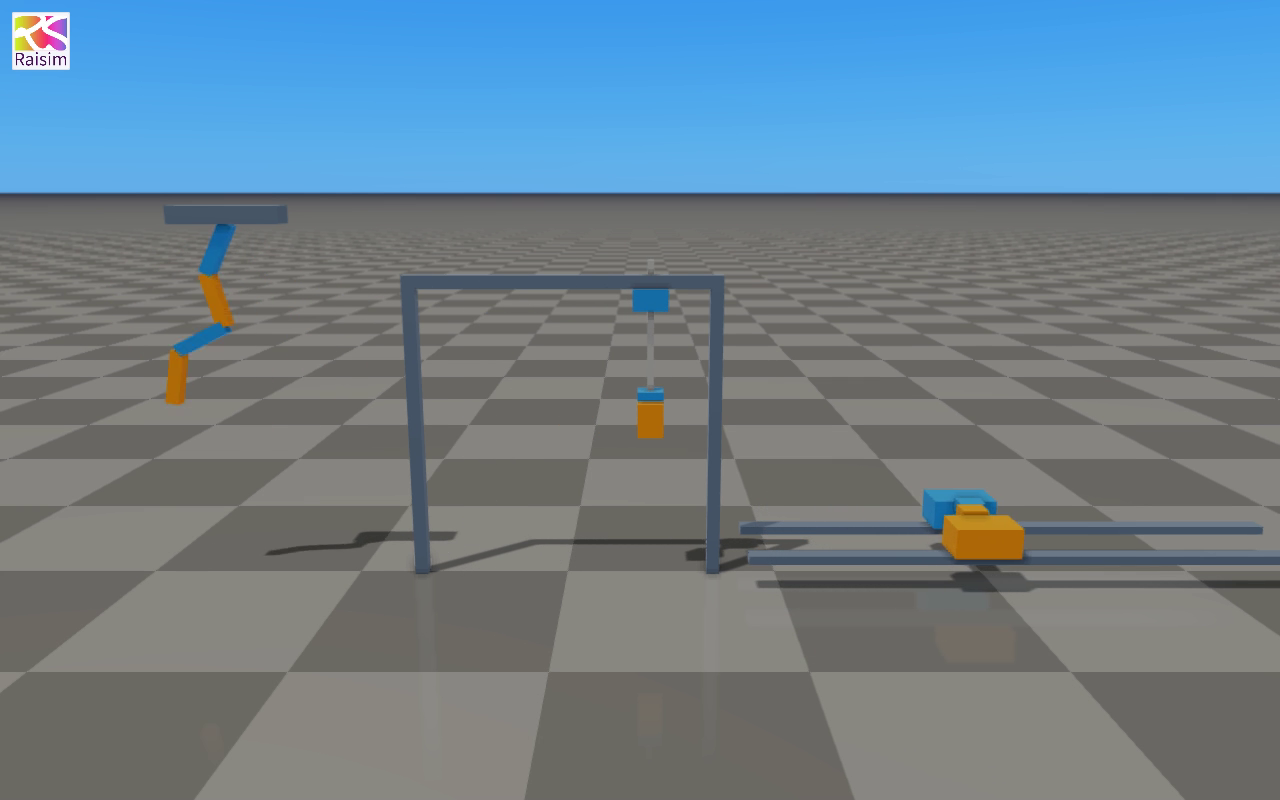
Joining two objects
raisim::World world;
auto* upper = world.addBox(0.2, 0.1, 0.4, 1.);
upper->setPosition(0., 0., 1.);
auto* lower = world.addBox(0.2, 0.1, 0.4, 2.);
lower->setPosition(0., 0., 0.6);

raisim::Joint hinge;
hinge.type = raisim::Joint::REVOLUTE;
hinge.name = "hinge";
hinge.pos_P = {0., 0., -0.2};  // joint frame in the parent body frame
hinge.axis = {0., 1., 0.};     // axis in the joint frame
hinge.limit = {-1., 1.};
hinge.damping = 0.1;

raisim::ArticulatedSystem* pendulum = world.joinObjects(upper, 0, lower, 0, hinge);
// upper and lower are removed from the world; their pointers are invalid now.
The arguments are the parent object and body, the child object and body, and a raisim::Joint, the same structure used to build an articulated system from a Child tree. The body index is 0 for a single body and system->getBodyIdx("link") for an articulated system. Pass nullptr as the parent (with body 0) to connect the child to the world; the joint frame is then given in world coordinates.
Joint::type | Relative motion of the child |
|---|---|
FIXED | None: the child becomes part of the parent body |
REVOLUTE | Rotation about axis |
PRISMATIC | Translation along axis |
SPHERICAL | Any rotation about the joint origin |
pos_P and rot place the joint frame in the parent body frame and axis is expressed in that joint frame. The joint must have a unique name. Its limits, damping, Coulomb friction, spring (stiffness, springMount), rotor inertia, effort limit and velocity limit act as they do in a URDF.
Configuration and frames
Nothing moves when objects are joined: every body keeps its world pose. The current configuration is the joint's reference position, Joint::jointRef (zero by default), so joint limits and spring rest positions are measured from it. Set jointRef to give the present pose a different coordinate.
As in URDF, the link frame of a body moved by a joint is the joint frame. After the join above, pendulum->getBodyPose(1, ...) reports the hinge frame, not the centre of the lower box. Collision and visual geometry, the centre of mass and the inertia are re-expressed in the new frame. The old link names remain: the child body is still "lower", and the new joint adds a frame named "hinge". A FIXED joint merges the child into the parent body, as fixed URDF links are; its link is then found with getFrameByName(jointName), not getBodyIdx().
Velocities and momentum
Joining is a perfectly inelastic connection. The new system's generalized velocity is the one with the same generalized momentum as the separate bodies that also satisfies its loop constraints, so linear and angular momentum are conserved, and kinetic energy is lost only in the directions the new joint removes. Bodies that already move rigidly together keep their velocities. Detaching keeps every body's velocity.
What the new system contains
Bodies keep their relative order. The child's bodies are inserted after the existing descendants of the parent body, so the indices of later bodies, and of their coordinates, can shift. Look up bodies, joints and frames by name rather than by index. The system takes the parent's name unless JoinOptions::name is set.
| Kept from the joined objects | |
|---|---|
| Inertia | Masses, centres of mass and inertias, including values changed at run time |
| Geometry | Collision shapes, materials, collision groups and masks, fluid coefficients, visual shapes and colors (a single body's numeric "r, g, b, a" appearance) |
| Joints | Types, axes, limits, damping, friction, every spring, rotor inertia, effort and velocity limits, fixed-link frames, and the forces, damping and limits of a floating base that stays the base |
| Control | Control mode, PD gains and targets, feedforward forces, actuators with their motor operating regions and torques |
| Devices | Thrusters and grippers on their links, with their thrusts and whether each gripper is on |
| Constraints | Pin, equality and mimic constraints of the robot descriptions, and earlier loop joints |
| Other | Ignored collision pairs, body segmentation labels, integration scheme, inverse-dynamics and motor-region settings |
If one object uses PD control and the other uses force control, the system uses PD control with zero gains on the force-controlled joints, which applies the same forces.
When two copies of one robot are joined, their link, joint, actuator, thruster and gripper names collide. JoinOptions::childPrefix prefixes every name from the child:
raisim::JoinOptions options;
options.childPrefix = "right/";
options.name = "pair";
auto* pair = world.joinObjects(left, 0, right, 0, dock, options);
pair->getBodyIdx("right/base");
Without a prefix, a name clash throws std::invalid_argument.
Connections to the world and closed loops
The parent keeps its connection to the world: a fixed base, a static body, or a floating base. The child depends on which of its bodies is joined:
- The child's base (body
0): the new joint replaces the child's own connection to the world. A fixed-base arm joined at its base to a mobile robot rides on the robot instead of staying fixed in place. A static body joined this way becomes dynamic. If the root represents the URDFworldlink, select one of its descendants. - Another body of the child: the child keeps its connection to the world. A floating child is re-rooted: its joints are re-oriented so that the joined body hangs from the parent, with the same motion as before. A child fixed to the world closes a loop through the world.
A joint that connects two bodies that are already connected, either two systems fixed to the world or two bodies of one system, closes a kinematic loop. It is enforced exactly as a loop-closure constraint, like the pin constraints of a URDF; the system has no coordinate for it, and it carries no limits, damping or actuation. The two bodies it connects do not collide with each other while it exists. getLoopJointNames() lists these joints.
// two carriages on fixed rails: docking them closes a loop
auto* docked = world.joinObjects(driven, driven->getBodyIdx("cart"),
                                 passive, passive->getBodyIdx("cart"), dock, options);
docked->getLoopJointNames();  // {"dock"}
To free an ordinary fixed-base system, pass its root joint name to detachJoint(). If the URDF retains the world link as the root, pass the name of the joint that connects the body to that link.
Detaching a joint
std::vector<raisim::ArticulatedSystem*> parts = world.detachJoint(pendulum, "hinge");
// parts[0]: the part with the root ("upper"), parts[1]: the part beyond the joint ("lower")
You can detach joints created by joinObjects(), movable or fixed joints from the robot description, loop joints, and ordinary fixed-base root joints. A body joined with a FIXED joint gets back its own mass, centre of mass, inertia and geometry. The part beyond the joint becomes a floating-base system named detachedName, or after the link the joint moved. A loop joint, or a joint whose two sides stay connected through a loop, leaves one system, whose loop joints may become ordinary joints. A part without mass, geometry or joints, such as the world anchor left when the only joint of a body hinged to the world is detached, is not kept. Detached parts stay articulated systems; a single released box is a one-body system with a floating base.
Rules and limitations
- Both operations replace objects: the input pointers become invalid. Use the returned systems,
World::getObject(name)or object ids. - Call them between complete steps; between
integrate1()andintegrate2()they throwstd::logic_error. Invalid input throwsstd::invalid_argumentbefore anything changes, leaving the world as it was. - A join or detach whose result could not be simulated, because a body would have no mass or a non-physical inertia (its mass matrix would be singular or indefinite), throws
std::invalid_argumentas well. - Remove tendons, wires and runtime joints attached to an object before joining or detaching it.
- Objects that cannot take part: kinematic bodies, the ground, height maps, cones, deformable and granular objects, meshes created from vertex arrays, meshes with a convex decomposition, and articulated systems with sensors or tracks. Collision meshes of the joined objects must use one mode, convex hull or original mesh.
- The joined system uses the parent's
ArticulatedSystemOptions, such asdoNotCollideWithParent, for all its bodies. - Re-rooting reverses the joints between the joined body and the old base. A reversed ball joint must have no effort limit and the same damping, rotor inertia and PD gains on its three axes.
- A joint whose two sides stay connected through a pin or equality constraint of the robot description (a closed linkage such as the Minitaur's legs) cannot be detached.
- A join or detach fails if surviving joints would lose a mimic relation or an actuator coupling.
- A body that merges fixed links can only be split if its mass properties still contain them. If its mass, centre of mass or inertia was changed at run time so that what remains for its own link would have a negative mass or an inertia that is not positive semidefinite, joining or detaching it fails. The split is resolved to about 1e-12 of the mass and inertia terms involved; smaller changes, such as tiny inertias next to the parallel-axis terms of links a kilometre apart, cannot be told from round-off and may be ignored or rejected.
- Single-body linear and angular damping, and the segmentation label of a body merged by a
FIXEDjoint, are not carried over. - A rebuilt system has no URDF text, so
World::exportToXml()cannot save it yet. Checkpoints taken before a join or detach are invalidated, as by any added or removed object.
Joined systems or runtime joints
Runtime joints keep both objects and enforce the joint with constraint impulses. Use them when the objects must stay separate, for breakable joints, joint reaction loads, and connections that are switched on and off often. Use joinObjects() for mechanisms that stay assembled: the joint is exact and the result is as fast as a robot loaded from a file.
The articulated_join_benchmark target compares an 8-link pendulum chain built both ways (eight chains, 1 ms timestep, gravity, one thread, AMD Ryzen 9 3950X):
| Chain | Time per step | Largest hinge separation |
|---|---|---|
joinObjects() | 12.9 µs | 1.4e-17 m |
| Runtime hinge joints | 1350 µs | 3.8e-6 m |
Joining a tool to an ANYmal takes 133 µs, and detaching it 134 µs. Each call rebuilds the system, so it is not meant for every step.
Python
import numpy as np
import raisimpy as r

world = r.World()
upper = world.addBox(0.2, 0.1, 0.4, 1.0)
upper.setPosition(np.array([0.0, 0.0, 1.0]))
lower = world.addBox(0.2, 0.1, 0.4, 2.0)
lower.setPosition(np.array([0.0, 0.0, 0.6]))

hinge = r.Joint(r.JointType.REVOLUTE, "hinge", position=[0.0, 0.0, -0.2], axis=[0.0, 1.0, 0.0])
hinge.limit = np.array([-1.0, 1.0])
options = r.JoinOptions()
options.name = "pendulum"
pendulum = world.joinObjects(upper, 0, lower, 0, hinge, options)
del upper, lower  # removed from the world

upper_part, lower_part = world.detachJoint(pendulum, "hinge")
Pass None as the parent to join to the world. raisimPy/examples/articulatedJoin.py carries and releases a tool with a gantry robot and docks two carriages.
Example, tests and benchmark
The Articulated Join example builds a chain from boxes, picks up and releases a tool, and docks two robots in one scene. testArticulatedJoin checks poses, momentum, mass properties, control settings and loop constraints through joins and detaches, including a Minitaur whose URDF loop constraints must reproduce the original motion after a round trip, and testPythonArticulatedJoin covers the Python bindings and example:
ctest --test-dir /path/to/test-build -j12 --output-on-failure \
  -R '^test(ArticulatedJoin|PythonArticulatedJoin|ArticulatedJoinExample)'
cmake --build /path/to/benchmark-build --target articulated_join_benchmark --parallel 12
/path/to/benchmark-build/benchmark/articulated_join_benchmark --copies 8 --links 8 --steps 5000