
Voxel Map
A voxel map is a static 3D occupancy map of cubic voxels. Unlike a height map, it can hold overhangs, caves, tunnels, rooms and floors above each other, and every voxel can be added or removed while the simulation runs. Bodies collide with it, and rays, lidars and depth cameras see it.
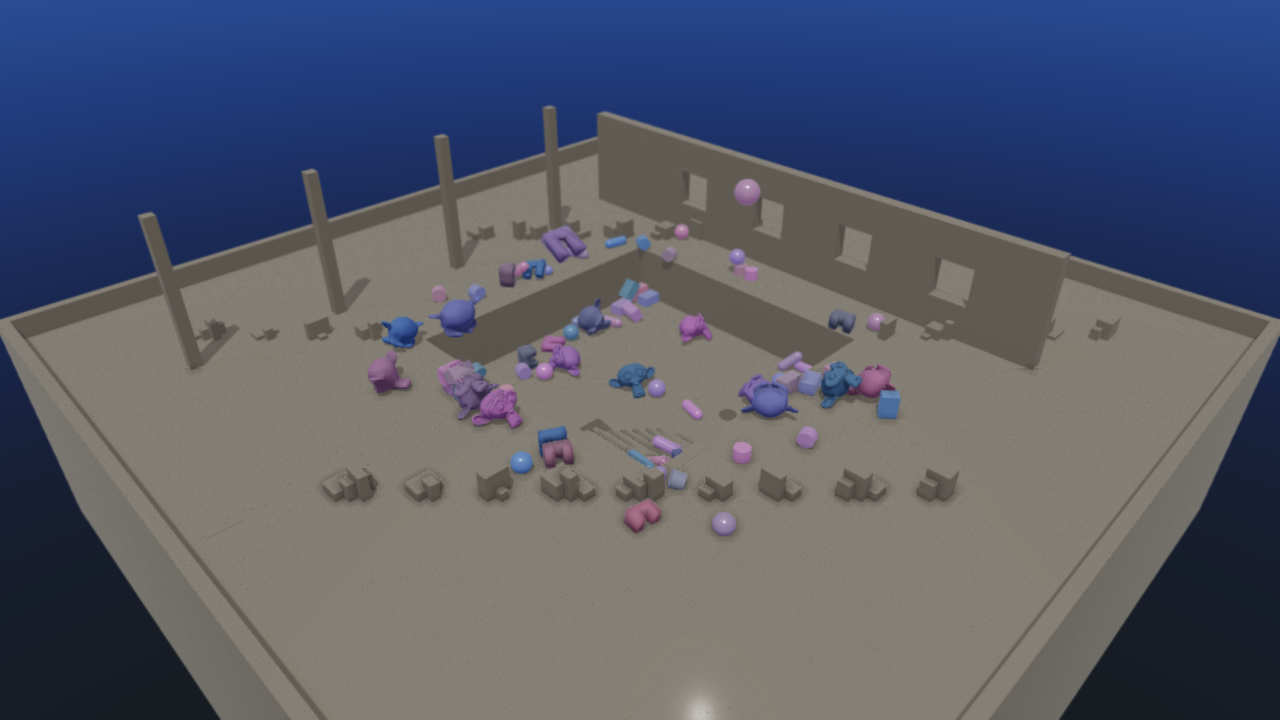
// a 30 m x 30 m x 8 m domain of 0.1 m voxels, starting at key (-150, -150, -10)
auto* voxels = world.addVoxelMap(0.1, {-150, -150, -10}, {300, 300, 80});
voxels->fillBox({-150, -150, -10}, {149, 149, -1}, true);   // a 1 m thick floor below z = 0
voxels->fillBox({20, -10, 0}, {40, 10, 30}, true);          // a block on it
voxels->fillSphere(raisim::Vec<3>{3.0, 2.0, 0.0}, 1.0, false);  // a crater
Voxels, keys and the map frame
Voxel key getVoxelSize()). Keys can be negative. A map holds the keys of its domain, [minKey, minKey + size) along each axis, chosen when it is created (getMinKey(), getDomainSize()); every voxel outside the domain is empty and edits there are ignored. A domain can span up to
The map frame is placed by the pose of the object, like every other object: setPosition() moves its origin and setOrientation() rotates it about that origin. A new map has the identity pose, so key getKey() returns the key of a point given in the map frame, getKeyAtWorldPosition() that of a world point, and getVoxelCenter() the world position of a voxel's center.
Creating and editing
| Method | Effect |
|---|---|
setVoxel(x, y, z, occupied) | Sets or clears one voxel. |
setVoxels(keys, occupied) | Sets or clears a list of voxels. |
fillBox(lo, hi, occupied) | Sets or clears the key box [lo, hi], both corners included. |
fillSphere(center, radius, occupied) | Sets or clears every voxel whose center lies within a sphere given in the map frame. |
setOccupancy(occupancy) | Replaces everything with a dense array over the domain, x fastest. |
clear() | Clears every voxel. |
Each returns how many voxels changed. Edits take effect at once, for contacts and ray tests alike. Sleeping bodies that reach an edited region wake at the next step, so a box resting on a floor that is carved away falls, and a body buried by filled voxels is pushed back out. isOccupied(), getOccupiedCount() and getOccupiedKeys() read the occupancy, and getRevision() changes with every change, to a value no other occupancy has had, also after a checkpoint is restored.
A VoxelMapResource (fromKeys(), fromOccupancy(), or makeResource() of an existing map) holds an occupancy that any number of maps, in one world or many, can share with World::addVoxelMap(resource). A map that shares a resource copies it only when it is first edited. World checkpoints (captureCheckpoint(), restoreCheckpoint()) restore the occupancy along with the rest of the world state without copying it at capture time.
World::exportToXml() throws std::runtime_error if the world contains a voxel map.
Collisions
Bodies collide with the surface of the occupied voxels: the faces, edges and corners that border empty space. A face that two occupied voxels share is inside the solid and never produces a contact, so a flat voxel floor is a flat floor: a body slides or rolls across the seams between its voxels without catching on them, and a body resting on it has exactly the contacts it would have on a ground plane at the same height. At a step, a body touches the step's edge with a normal that turns from the top face to the side face as it rounds the edge, and in a corner it touches both walls.
Every collidable shape collides with a voxel map: spheres, boxes, capsules, cylinders, convex meshes, triangle meshes, compounds, the collision bodies of articulated systems, and the particles of deformable objects. A body that ends up inside the solid, because it was placed there or the voxels around it were filled, is pushed out toward the nearest free side. That side can be the far side of a thin layer, or the bottom of the map when the space above is blocked, since everything outside the domain is empty. The push works like the recovery from any overlap in RaiSim: a body 5 cm deep takes about two seconds to come out. Filling a large region under resting bodies at once buries them; filling it a layer at a time lifts them gradually.
A voxel map is static (or kinematic): setBodyType(BodyType::DYNAMIC) is an error, and two voxel maps do not collide with each other. Granular media and swept continuous collision detection do not see voxel maps yet. The scene collision queries (World::queryProximity(), queryOverlap(), checkOverlap(), sweepShape()) treat a voxel map as the solid union of its occupied voxels. Their contact tolerance is 1 nm; far from the origin (beyond about
Ray tests
World::rayTest(), World::rayTestLidar() and the lidar, depth and segmentation sensors hit a voxel map at the first face of an occupied voxel along the ray. The reported position lies exactly on that face and the normal is the face's normal, facing the ray's origin. A ray that runs exactly along an edge or through a corner between voxels enters only the voxels beyond it, not those beside it. A ray that starts inside the solid reports where it leaves the solid, as rays starting inside a primitive do.
Performance
A ray costs in proportion to the occupied voxels it passes close to, not to the size of the map: it skips empty space in large steps. Spinning-lidar scans of a 48 m x 48 m terrain of 0.1 m voxels take about 250 ns per ray on an AMD Ryzen 9 3950X, half the time of the same terrain stored as a height map.
rayrai's GPU LiDAR (see Depth and LiDAR) returns the same points as the CPU LiDAR on voxel maps. A full turn of an Ouster OS1-64 over a voxel terrain takes 0.4 to 0.5 ms on an RTX 2070 SUPER, about 22 times faster than on the CPU. The map is uploaded on its first scan, and an edit uploads only the 16³-voxel bricks it changed. Voxel ray casting compares the CPU and GPU ray casts with OpenVDB, NanoVDB, Bonxai and OctoMap.
A body resting on a flat voxel floor costs about four times as much contact detection as one on a ground plane: about 0.35 µs for a sphere and 0.7 µs for a box on 5 cm voxels. Rough ground costs more, since every edge and corner a body touches is tested: a box on voxel rubble takes about 2.4 µs, and a detailed convex mesh tens of microseconds. Carving or filling a sphere of radius 0.3 m out of 5 cm voxels takes about 10 µs.
Visualization
The rayrai TCP viewer draws a voxel map as one instanced batch with a cube for every voxel that has an empty neighbor; voxels enclosed on all six sides cannot be seen and are not drawn. It receives the occupancy through the PROTOCOL_FEATURE_VOXEL_MAPS feature (see RaisimServer); the server sends it again only after the map changes. rayrai windows that draw a World directly show the map's surface as one mesh. setAppearance() takes a color.
Python
voxels = world.addVoxelMap(0.1, [-150, -150, -10], [300, 300, 80])
voxels.fillBox([-150, -150, -10], [149, 149, -1], True)
voxels.setVoxels(np.array([[0, 0, 0], [1, 0, 0]]), True)  # any integer dtype
occupied = voxels.getOccupiedKeys()   # (n, 3) int32 array
voxels.setOccupancy(dense)            # array of shape (size_z, size_y, size_x); nonzero is occupied
Examples
voxel_map_ray_casting: a spinning lidar and a probe ray scan a voxel map with hills, a hut, an arch and a tunnel.voxel_map_collision: spheres, boxes, capsules, cylinders, convex meshes and triangle meshes fall onto voxel stairs, walls, rubble and a pit, while new craters are carved into the floor.