
Voxel Ray Casting
RaiSim's voxel map ray cast is compared with the voxel libraries robotics and graphics code commonly use, on the CPU and on the GPU, with the same scenes and the same rays.
- CPU: RaiSim casts a lidar ray in 172–301 ns, 1.7–2.0× faster than NanoVDB, 3.3–4.0× faster than OpenVDB, 4.7–9.5× faster than Bonxai and 22–34× faster than OctoMap. RaiSim and OpenVDB return every hit exactly; NanoVDB's ray marcher reports a different voxel or distance for 84–97 % of the rays.
- GPU: rayrai's GPU LiDAR casts a ray in 0.9–3.3 ns, 1.3–1.8× faster than NanoVDB in CUDA, and returns the CPU's points ray by ray.
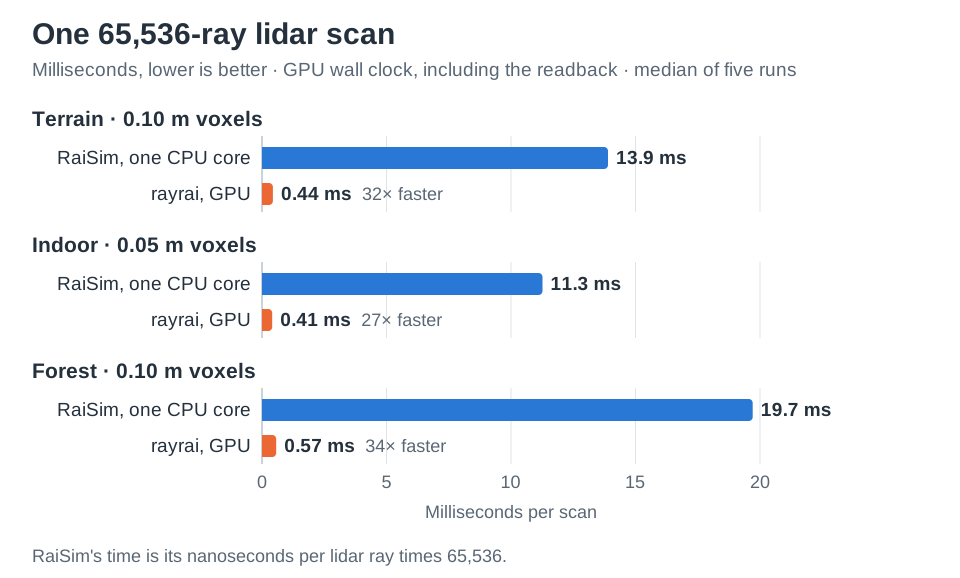
- CPU and GPU: a 65,536-ray scan takes 11–20 ms on one CPU core and 0.41–0.57 ms with rayrai, 27–34× faster.
- Edits: after carving or filling a sphere, rayrai uploads only the parts of the map that changed. The next scan takes 0.44–0.56 ms, about as long as any other scan. NanoVDB has to rebuild and upload the whole grid, which takes 7.0–18.5 ms.
Setup
| CPU | AMD Ryzen 9 3950X, one thread pinned to one core, Linux x86-64, Clang 20 Release (-O3 -march=x86-64-v3) |
| GPU | NVIDIA GeForce RTX 2070 SUPER, driver 580.178.04, OpenGL 4.3 (rayrai) and CUDA 13.3 |
| Libraries | OpenVDB 14.0.0 and the NanoVDB 32.11.0 it ships, Bonxai 0.8.0, OctoMap 1.10.0 |
Each library casts rays with its own ray routine: OpenVDB's VolumeRayIntersector with its DDA inside leaves, NanoVDB's firstActive (its hierarchical DDA, the same code on the CPU and in CUDA), Bonxai's ExactRayIterator and OctoMap's castRay. A dense bit grid stepped voxel by voxel (dense DDA) is the reference: every other result is compared with it, ray by ray. The grids are built from the same list of occupied voxels.
| Scene | Voxel | Size | Occupied voxels | Contents |
|---|---|---|---|---|
| terrain | 0.10 m | 51 m × 51 m × 10 m | 7.6 M | hills, 40 buildings, 10 platforms on legs, 6 tunnels |
| indoor | 0.05 m | 30 m × 30 m × 9 m | 6.2 M | three storeys of 25 rooms with doors, windows, stairs and furniture |
| forest | 0.10 m | 100 m × 100 m × 13 m | 9.7 M | 600 trees with hollow crowns and 200 boulders on rolling ground |
Each scene is scanned by eight lidars at random free positions, 1,024 × 64 rays each over pitch −25° to 15° with a 100 m range (524,288 rays), and by 200,000 rays from random free points in random directions with a 50 m range.
CPU
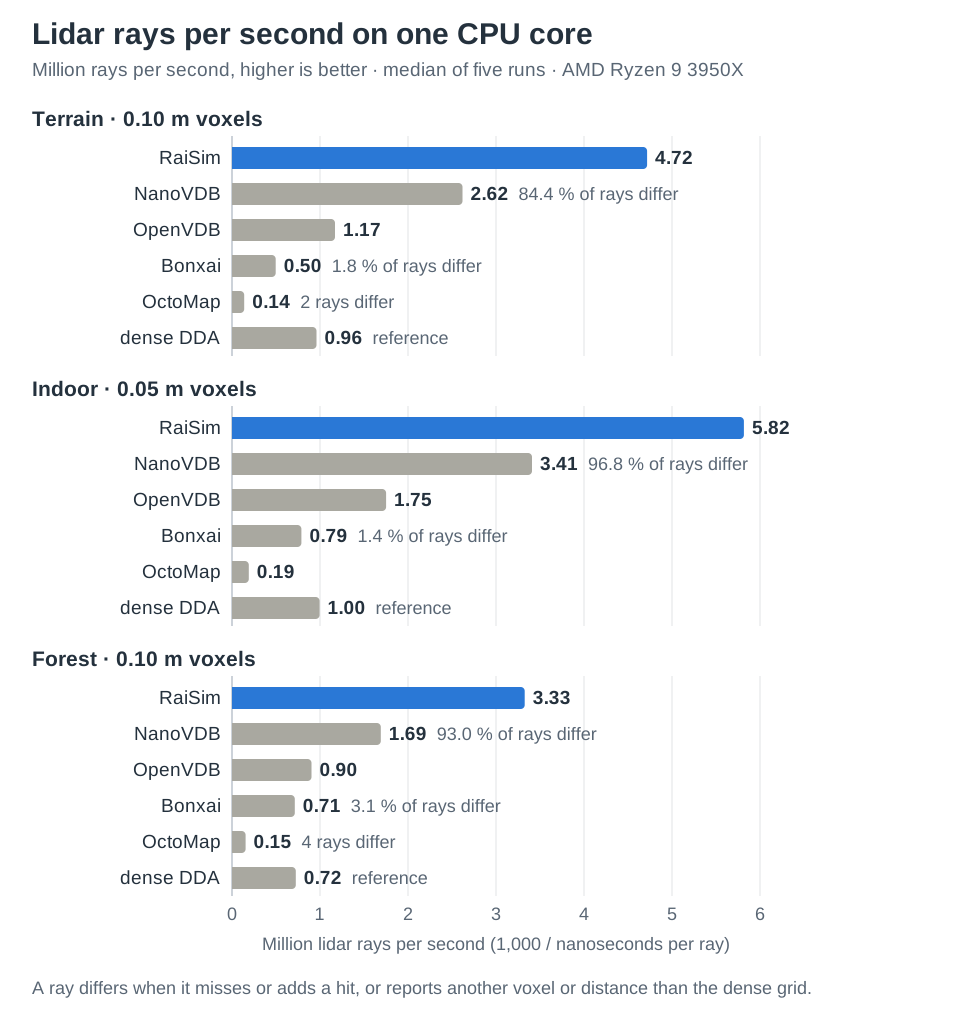
Nanoseconds per ray, one thread; lower is better. Median of five runs.
| Scene | Rays | RaiSim | NanoVDB | OpenVDB | Bonxai | OctoMap | dense DDA |
|---|---|---|---|---|---|---|---|
| terrain | lidar | 212 | 382 | 854 | 2,015 | 7,205 | 1,041 |
| random | 251 | 409 | 663 | 3,704 | 10,320 | 1,022 | |
| indoor | lidar | 172 | 293 | 571 | 1,268 | 5,237 | 1,004 |
| random | 272 | 396 | 643 | 1,068 | 3,712 | 715 | |
| forest | lidar | 301 | 592 | 1,108 | 1,401 | 6,470 | 1,380 |
| random | 337 | 538 | 921 | 2,643 | 8,126 | 1,076 |
Lidar rays that differ from the reference (a missed or extra hit, another voxel, or another distance):
| Scene | RaiSim | NanoVDB | OpenVDB | Bonxai | OctoMap |
|---|---|---|---|---|---|
| terrain | 0 | 84.4 % | 0 | 1.8 % | 2 rays |
| indoor | 0 | 96.8 % | 0 | 1.4 % | 0 |
| forest | 0 | 93.0 % | 0 | 3.1 % | 4 rays |
NanoVDB's firstActive returns where its DDA steps into a voxel rather than the voxel's face, one to two voxels too far on average, and it steps into a voxel beside the ray at some edges and corners. Bonxai's iterator does the same at 1–3 % of the rays. OctoMap works in single precision. RaiSim reports the face the ray enters, and a ray along an edge or through a corner enters only the voxels beyond it (see Ray tests).
Building the grid and its memory:
| Scene | RaiSim | NanoVDB | OpenVDB | Bonxai | OctoMap | dense DDA | |
|---|---|---|---|---|---|---|---|
| terrain | build (ms) | 32 | 50 | 43 | 37 | 1,251 | 37 |
| memory (MB) | 2.1 | 4.8 | 4.5 | 13.5 | 28.3 | 3.3 | |
| indoor | build (ms) | 30 | 48 | 41 | 37 | 993 | 28 |
| memory (MB) | 8.5 | 8.0 | 7.4 | 25.5 | 30.5 | 7.9 | |
| forest | build (ms) | 74 | 102 | 91 | 100 | 1,765 | 47 |
| memory (MB) | 17.0 | 18.6 | 17.2 | 57.6 | 254.3 | 15.6 |
The dense grid's memory grows with the volume of its domain; the others grow with the occupied voxels.
GPU
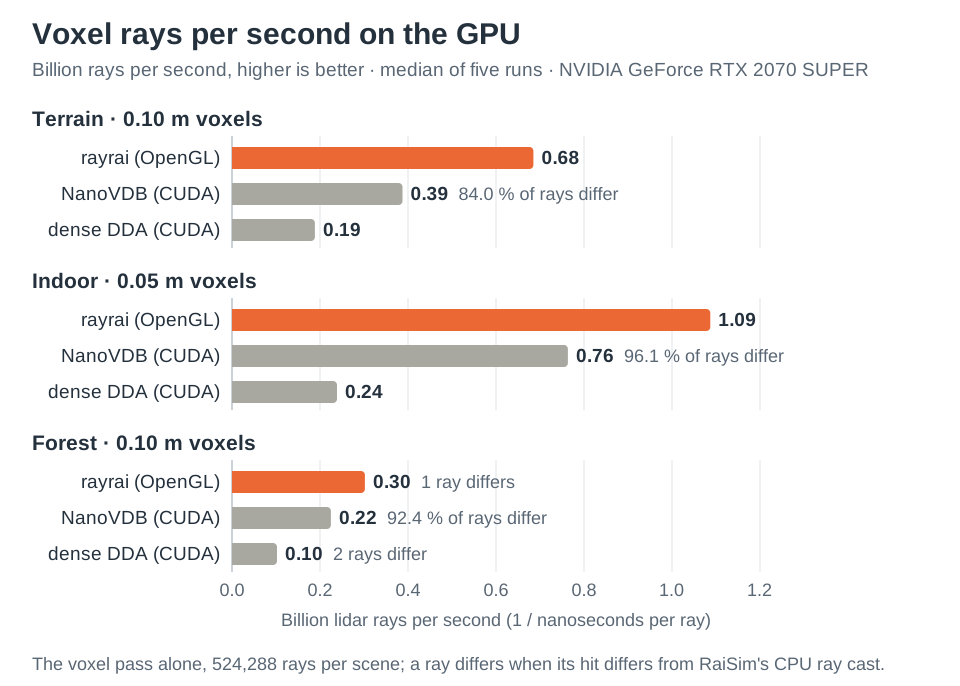
Nanoseconds per ray for the voxel pass alone; lower is better. Median of five runs, rayrai and CUDA taking turns, 524,288 lidar rays per scene. rayrai's pass is timed with an OpenGL timer query, the CUDA kernels with CUDA events.
| Scene | rayrai (OpenGL) | NanoVDB (CUDA) | dense DDA (CUDA) |
|---|---|---|---|
| terrain | 1.46 | 2.58 | 5.31 |
| indoor | 0.92 | 1.31 | 4.19 |
| forest | 3.31 | 4.45 | 9.78 |
Rays that differ from RaiSim's CPU ray cast:
| Scene | rayrai | NanoVDB | dense DDA |
|---|---|---|---|
| terrain | 0 | 84.0 % | 0 |
| indoor | 0 | 96.1 % | 0 |
| forest | 1 ray | 92.4 % | 2 rays |
rayrai works in single precision, so a ray that passes within rounding of a voxel edge can enter or skip the voxel beside it; one ray in 1.5 million did.
CPU and GPU
A full 65,536-ray scan through rayrai's GPU LiDAR (measureSpinningLidarSingleDrawGPU) includes building the ray table, drawing every body and reading the ranges back (median of five runs, in the same runs as the edits):
| Scene | CPU (RaiSim, one thread) | GPU (rayrai), GPU time | GPU (rayrai), wall clock | Speedup |
|---|---|---|---|---|
| terrain | 13.9 ms | 0.39 ms | 0.44 ms | 32× |
| indoor | 11.3 ms | 0.37 ms | 0.41 ms | 27× |
| forest | 19.7 ms | 0.52 ms | 0.57 ms | 34× |
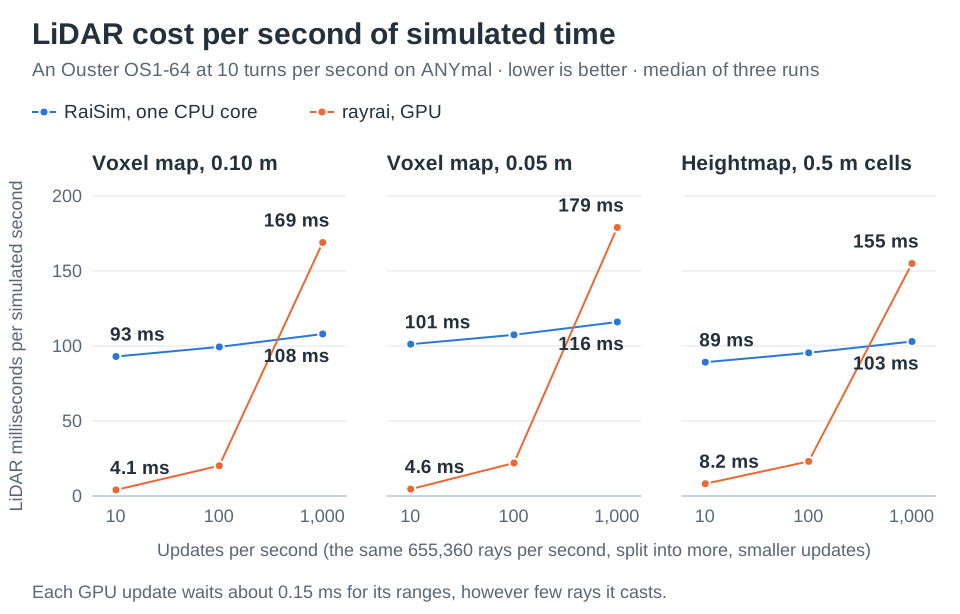
On a robot, rayrai_lidar_benchmark scans an 84 m × 84 m terrain with 200 obstacles with an Ouster OS1-64 (512 × 64 rays per turn, 10 turns per second) on ANYmal. The two lidars are twins and return the same points; no return differs. The chart adds up the time per second of simulated time; the table gives it per update. Medians of three runs:
| Terrain | Updates per second | CPU per update | GPU per update | GPU speedup |
|---|---|---|---|---|
| voxel map, 0.10 m | 10 | 9.30 ms | 0.41 ms | 23× |
| 100 | 994 µs | 202 µs | 4.9× | |
| 1,000 | 108 µs | 169 µs | 0.6× | |
| voxel map, 0.05 m | 10 | 10.12 ms | 0.46 ms | 22× |
| 100 | 1,075 µs | 220 µs | 4.9× | |
| 1,000 | 116 µs | 179 µs | 0.6× | |
| heightmap, 0.5 m cells | 10 | 8.92 ms | 0.82 ms | 11× |
| 100 | 955 µs | 231 µs | 4.1× | |
| 1,000 | 103 µs | 155 µs | 0.7× |
A GPU update waits for its ranges to come back, about 0.15 ms, however few rays it casts. Updated every 1 ms physics step, each update casts 328 rays, which the CPU does faster; at 100 updates per second (3,277 rays each) the GPU is 4 to 5 times faster.
Edits
A sphere of 0.5 m radius is carved out of or filled into the map 3 to 7 m from the sensor, and the next scan is timed (median of five runs, rayrai and NanoVDB taking turns):
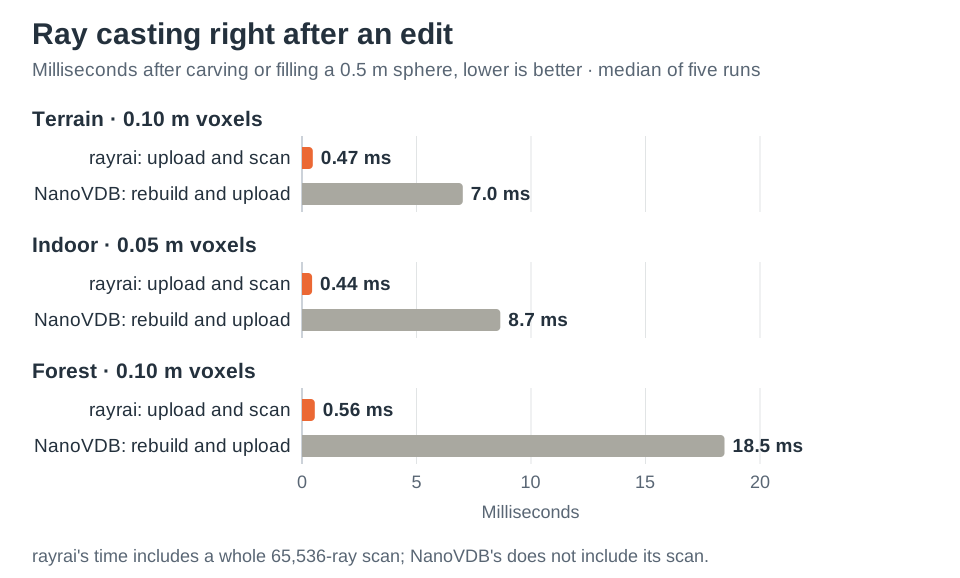
| Scene | rayrai: scan after the edit | rayrai: upload of the edit | NanoVDB: rebuild and upload |
|---|---|---|---|
| terrain | 0.47 ms | 0.01–0.04 ms | 7.0 ms |
| indoor | 0.44 ms | 0.01–0.04 ms | 8.7 ms |
| forest | 0.56 ms | 0.01–0.04 ms | 18.5 ms |
rayrai uploads only the 16³-voxel bricks the edit changed. A NanoVDB grid cannot be edited in place, so the time is that of NanoVDB's grid builder adding the sphere's voxels, converting the grid and copying it to the GPU; removing voxels needs a build from the source data. On the robot above, a turn right after an edit takes 0.44 ms with 0.10 m voxels and 0.51 ms with 0.05 m voxels.
Reproduce
Download the recorded results, from which the tables and charts on this page are made. The comparisons with other libraries use an internal harness that is not distributed. RaiSim's own measurements come from the benchmark runner of the RaiSim source repository, which the binary package does not ship (see Build, Test, and Benchmark):
taskset -c 2 ./build-benchmark/benchmark/benchmarks -b voxel_lidar -b voxel_contacts -b voxel_edit --raisim
taskset -c 2 ./build-benchmark/visualizer/rayrai/rayrai_lidar_benchmark --voxel-size=0.1
taskset -c 2 ./build-benchmark/visualizer/rayrai/rayrai_lidar_benchmark --voxel-size=0.05
taskset -c 2 ./build-benchmark/visualizer/rayrai/rayrai_lidar_benchmark
voxel_lidar times lidar scans of a terrain as a voxel map and as a heightmap, voxel_contacts a pile of bodies on voxel rubble and voxel_edit carving spheres out of a map. rayrai_lidar_benchmark prints the robot table above; without --voxel-size it scans the heightmap. Timings depend on the machine, compiler and driver.